
What Is Inquiry-Based Learning in Preschool? Examples, Benefits & Activities
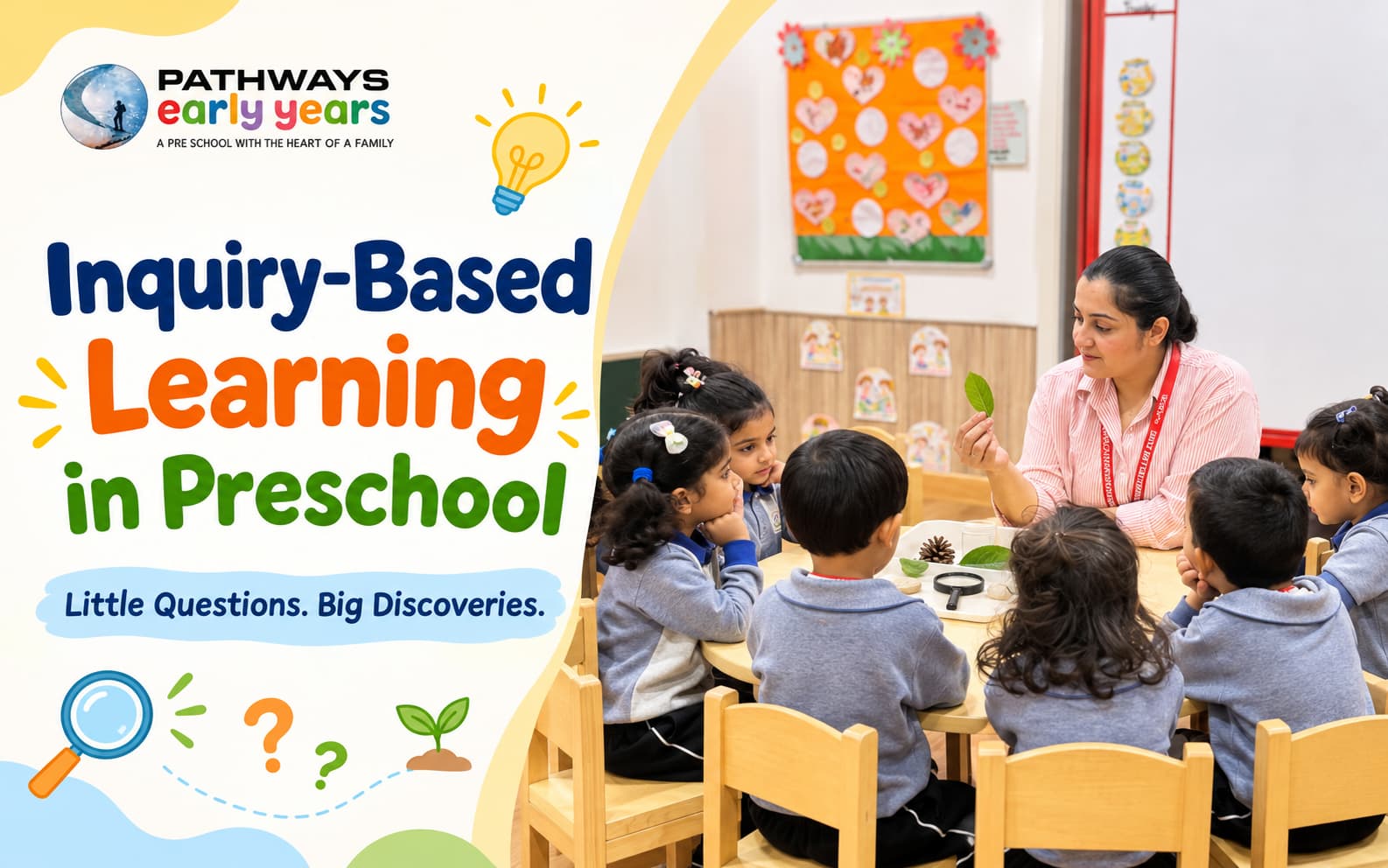
Inquiry-based learning in preschool is a child-led approach where children ask questions, explore materials and discover answers through hands-on play, helping build curiosity, language skills and critical thinking.
Every parent of a three-year-old knows the question that never ends: "Why?" Why is the sky blue? Why do leaves fall? Why does the ice melt? Instead of treating these questions as interruptions, inquiry-based learning in preschool treats them as the starting point of education.
If you are a parent in Shalimar Bagh comparing preschools, this guide explains what inquiry-based learning is, how it works in a real classroom, which activities support it and what benefits you can expect for your child.
Quick answer: Inquiry-based learning in preschool is a child-led teaching approach where children ask questions, explore materials, test ideas and discover answers through hands-on play, with teachers guiding rather than simply telling.
Key Takeaways
• Inquiry-based learning in early childhood education starts with a child's own questions and curiosity.
• Children learn through exploration, observation and hands-on experiences, not memorisation.
• Teachers act as facilitators who ask open-ended questions and set up rich learning environments.
• Benefits include stronger critical thinking, language, confidence, creativity and social skills.
• Simple activities such as sink-or-float tests, seed planting and sensory bins work well for 3 to 5 year olds.
What Is Inquiry-Based Learning in Preschool?
Inquiry-based learning is an approach in which children learn by investigating questions that interest them. Rather than being handed a fact, a child is encouraged to wonder, explore, try things out and arrive at an understanding on their own, with a teacher nearby to guide the process.
In a preschool setting, this is child-led learning built around curiosity. A child who notices a snail on the garden path might ask where it lives or what it eats. The teacher turns that moment into a short investigation with observation, drawing, discussion and sometimes a small experiment.
This approach is closely linked to experiential learning in preschool and play-based learning. Play is the vehicle, and inquiry is the thinking that happens inside it.
How is it different from traditional teaching?
In a traditional classroom, the teacher usually presents information and children repeat it. In an inquiry-based preschool, children generate the questions, handle real materials and explain what they notice. The teacher's role shifts from "giver of answers" to "guide of discovery."
Feature | Traditional Approach | Inquiry-Based Approach |
Who leads | Teacher | Child, guided by teacher |
Main method | Listening and repeating | Exploring and questioning |
Learning style | Memorisation | Hands-on and experiential |
Teacher role | Instructor | Facilitator |
Outcome | Recall of facts | Understanding and critical thinking |
How Does Inquiry-Based Learning Work in Early Childhood Education?
Inquiry-based learning in early childhood education usually follows a simple, repeating cycle. It does not need to be rigid, and it adapts to the age and interests of the group.
1. Wonder: A child notices something interesting or asks a question.
2. Explore: Children touch, observe, collect and experiment with real objects.
3. Investigate: The teacher asks open-ended questions such as "What do you think will happen?"
4. Create: Children draw, build, role-play or retell what they found.
5. Reflect: The group talks about what they learned and what they still wonder about.
This cycle supports learning through exploration and naturally builds language, as children describe what they see, predict outcomes and explain their thinking.
Benefits of Inquiry-Based Learning for Preschool Children
The benefits of inquiry-based learning for preschool children go well beyond academic readiness. Because the approach respects how young children naturally learn, it supports the whole child.
1. Builds critical thinking in young children
When children predict, test and revise their ideas, they practise reasoning from a very early age. Asking "why" and "what if" becomes a habit.
2. Strengthens language and communication
Children describe observations, ask questions and listen to peers. This expands vocabulary and sentence structure in a meaningful context.
3. Nurtures curiosity-driven learning
A child who is encouraged to ask questions stays motivated to learn. Curiosity keeps learning interesting and meaningful for young children.
4. Boosts confidence and independence
Children feel their ideas matter. They learn that it is fine to try, make mistakes and try again.
5. Develops social and emotional skills
Group investigations teach turn-taking, sharing materials, respecting different opinions and working towards a common goal.
6. Supports early childhood development across domains
Hands-on exploration develops fine motor skills, early maths and science concepts, creativity and problem-solving together, instead of in isolated lessons.
Inquiry-Based Learning Examples in a Preschool Classroom
Parents often ask what this looks like day to day. Here are practical inquiry-based learning examples that show how everyday moments become learning opportunities.
Example 1: The rainy-day question. After a monsoon shower, children ask where the puddles go. The teacher lets them draw chalk circles around puddles, check them again after an hour and discuss what changed. This introduces evaporation, observation and measurement in a natural way.
Example 2: The class vegetable basket. Children bring vegetables from home, sort them by colour, size or shape, feel their textures and predict which ones will sink or float. This builds early maths, vocabulary and scientific thinking.
These examples of inquiry-based learning in early childhood education share one feature: the learning grows from the child's own curiosity and real experience.
Inquiry-Based Learning Activities for 3 to 5 Year Olds
If you are looking for inquiry-based learning activities for 3 to 5 year olds, these simple ideas work in classrooms and at home. They need very few materials and allow children to learn through hands-on learning experiences.
For 3 to 4 year olds
• Sink or float: Gather everyday objects and let children predict, then test, in a tub of water.
• Sensory bins: Fill a tray with rice, sand or water beads and hidden objects to explore with touch.
• Colour mixing: Mix red, yellow and blue paint and ask, "What colour do you think we will get?"
• Nature walk: Collect leaves, stones and flowers, then sort and talk about them.
For 4 to 5 year olds
• Seed planting: Plant seeds in cups, predict how they will grow and draw changes each day.
• Magnet exploration: Test which objects stick to a magnet and why some do not.
• Ramp and roll: Build ramps with books and test which toys roll fastest.
These inquiry based learning activities work best when adults ask questions instead of giving answers. Try "What do you notice?", "What do you think will happen?" and "How could we find out?"
Looking for a preschool in Shalimar Bagh? Contact Pathways Early Years to ask about admissions: +91 93195 44066 or admissions.sb@pathways.in.
Inquiry-Based Learning vs Play-Based Learning
These two ideas are often mentioned together, and they overlap. Play-based learning lets children learn through free and guided play. Inquiry-based learning adds purposeful questioning and investigation to that play. In a strong preschool programme, the two work together: play creates the opportunity, and inquiry deepens the thinking. You can see this kind of joyful, hands-on learning in the Pathways Early Years events and photo gallery.
How Do Teachers Encourage Curiosity and Exploration in Preschool?
Understanding how teachers encourage curiosity and exploration in preschool helps parents recognise a genuinely inquiry-driven classroom. Look for these practices:
• Open-ended questions that have more than one possible answer.
• Observation and documentation, where teachers note what children are curious about and plan the next activity around it.
• Patience with mistakes, treating errors as part of discovery.
• Child voice, where children help choose topics and share their findings.
How Parents Can Support Inquiry-Based Learning at Home
You do not need special equipment to continue this approach at home. Programmes such as Holding Hands offer gentle guidance for early development. A few small habits make a big difference:
• Answer a question with a question: "What do you think?"
• Cook together and let your child predict what will happen when ingredients are mixed or heated.
• Take evening walks in your colony park and ask your child what they notice.
How Pathways Early Years Encourages Curious Learners
Pathways Early Years in Shalimar Bagh describes its vision as celebrating the uniqueness of each child and encouraging them to be inquisitive explorers in a safe and loving environment. That vision fits naturally with the spirit of inquiry-based learning.
The school's "Happy Learning Through Play" approach includes:
• Creative Play: painting, drawing and crafting to spark imagination
• Early Math Fun: learning numbers with toys, blocks and games
• Music & Movement: dancing, singing and joyful movement every day
• Friends & Sharing: building friendships through play and teamwork
The Pre School programme offers a joyful start to learning through play and discovery, and school events such as summer camp and dance performances give children more ways to explore and express themselves.
What to Look for in an Inquiry-Based Preschool in Shalimar Bagh
When visiting preschools, ask how they put inquiry into daily practice. Useful questions include:
• How do you plan activities around children's interests?
• What does a typical day look like, and how much is hands-on exploration?
• How do teachers document and share each child's progress?
• How do you balance free exploration with early literacy and numeracy?
• Can I observe a classroom or attend a trial session?
At Pathways Shalimar Bagh, the After School Programmes offer fun, engaging learning beyond school hours and encourage creativity and independence. To ask about admissions or a school visit, use the enquiry option on the website.
Conclusion
Inquiry-based learning in preschool turns a child's natural curiosity into a lasting love of learning. Through hands-on exploration, thoughtful questioning and guided reflection, children build critical thinking, language and confidence while enjoying every step.
If you are exploring preschool options in Shalimar Bagh, look for a school where curiosity is encouraged, questions are valued and learning is joyful. To learn more about early learning at Pathways, enquire about admissions or a school visit today.
Pathways Early Years, Shalimar Bagh
Address: NS-4, AD Block, Poorbi Shalimar Bag, Shalimar Bagh, Delhi, 110088
Phone: +91 93195 44066, +91 93195 44766
Email: admissions.sb@pathways.in
About the Author
Pathways Early Years Team
Frequently Asked Questions
It is a child-led approach where children ask questions, explore real materials and discover answers through hands-on play. Teachers guide with open-ended questions rather than simply giving information.
Examples include testing which objects sink or float, watching puddles dry after rain, planting seeds, recording growth and sorting vegetables by colour, size or shape.
It builds critical thinking, language, confidence, creativity, independence and social skills. It also keeps children curious and motivated about learning.
No, but they are closely connected. Play-based learning uses play as the main way of learning, while inquiry-based learning adds questioning, investigation and reflection to that play.
Children can begin as early as two to three years old through sensory exploration and simple questions. The activities become more structured as they grow.
Yes. Inquiry-based learning builds language, early numeracy, concentration and problem-solving. Good programmes also include early literacy and numeracy so children transition to Class 1 with confidence.
Look for open-ended questioning, hands-on materials, children's work displayed on walls, flexible routines and teachers who document and respond to children's interests.
Ask "what do you think?", involve your child in cooking, gardening and walks, keep simple exploration materials available and celebrate their questions instead of rushing to answer.
Get in Touch
Still have questions? Fill out the form below and our team will get back to you shortly.