
Differences Between Preschool and Primary School: A Parent’s Guide
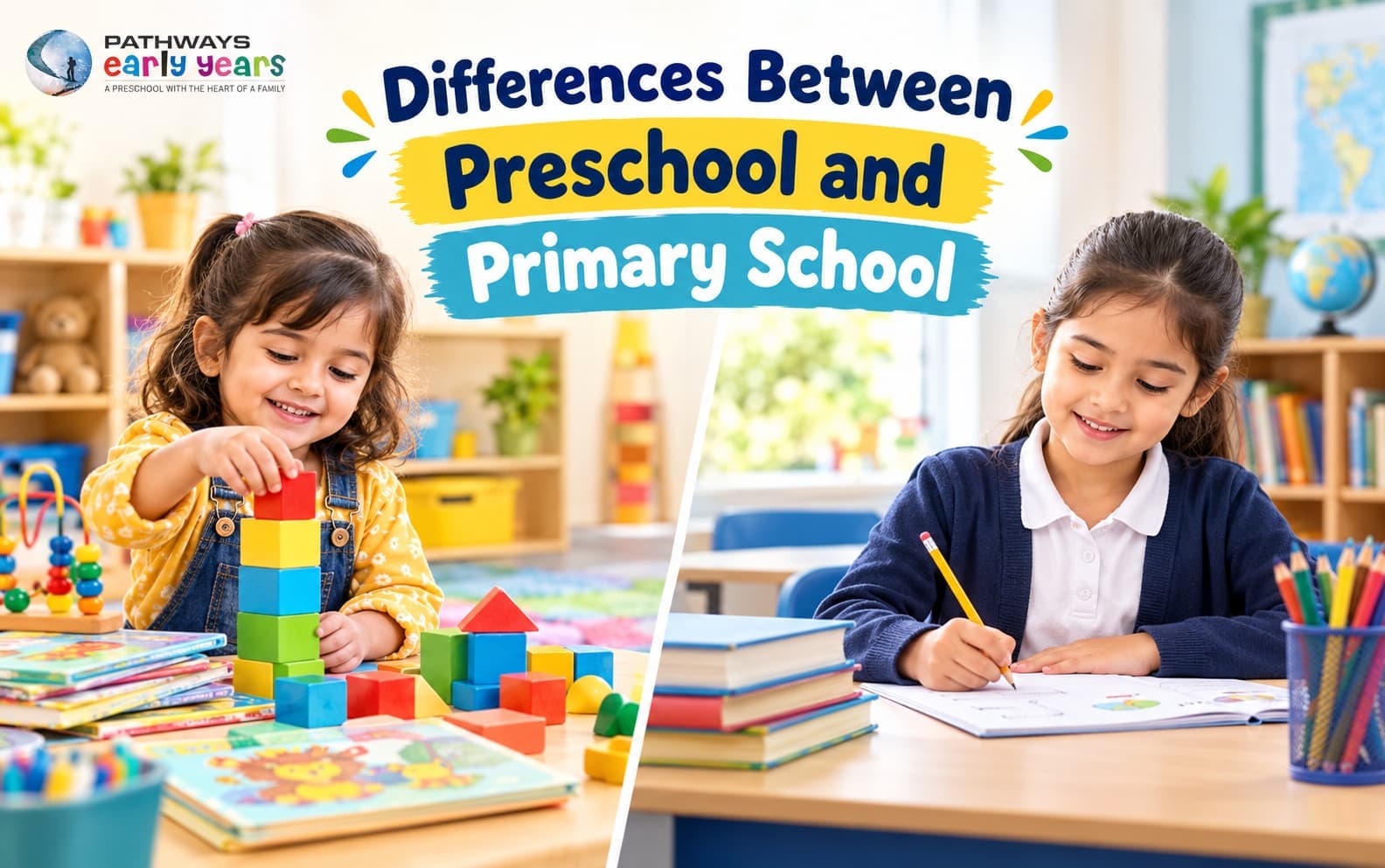
The main differences between preschool and primary school are learning style, structure and school day. Preschool uses play-based learning to build early skills and confidence, while primary school follows structured, subject-based lessons.
Choosing the right learning stage is one of the first big decisions parents make, and understanding the differences between preschool and primary school makes that decision easier. Both stages involve classrooms, teachers and friends, but they work very differently for a child.
Preschool focuses on play, curiosity and confidence. Primary school builds on that base with structured, subject-based lessons. This guide explains how learning style, curriculum, school day and teacher support change between the two, and how you can help your child make the move with confidence.
Key Takeaways
• Learning style: Preschool teaches through play, creative activities and hands-on exploration. Primary school moves towards structured, subject-based lessons.
• Age stages: At Pathways Early Years, preschool programmes run from 12 months to 6 years and end with Kindergarten, which comes before primary school.
• School day: Preschool days are shorter. At Pathways Early Years, sessions run from 3 to 5 hours depending on the age group, while primary school is generally a full school day.
• Focus: Preschool builds social, emotional and motor skills first. Primary school uses those skills to develop language, numeracy and subject knowledge.
• Readiness: A child is ready for primary school when they are curious, confident and able to communicate, not only when they can read or write.
What Is the Main Difference Between Preschool and Primary School?
The main difference is how children learn. Preschool uses play-based learning and hands-on activities to build early skills and confidence, while primary school uses structured lessons and defined subjects to build academic knowledge.
The school day, the teacher’s role and the expectations placed on a child all follow from this single shift. Think of preschool as the stage where children learn how to learn. They explore, make friends, share and express themselves. Primary school is where they use those skills to read, write, count and study different subjects. Neither stage matters more, because each one prepares the child for the next.
What Is Preschool and What Do Children Learn There?
Preschool is the first stage of formal early education, where children learn through play and discovery before they begin primary school. It introduces routines, friendships and early learning in a safe and caring setting.
A good preschool curriculum grows with the child. At Pathways Early Years, a preschool in Shalimar Bagh, Delhi, programmes are organised by age. Pre-Toddlers cover 12 months to 2 years, Toddlers 2 to 3 years, Pre-Nursery 3 to 4 years, Nursery 4 to 5 years and Kindergarten 5 to 6 years. Sessions run for 3 hours in the first two stages, 4 hours in Pre-Nursery and 5 hours in Nursery and Kindergarten.
Learning is child-led and experiential. Children enjoy painting, drawing and crafting, learn early maths with toys, blocks and games, and take part in music and movement through singing and dancing. They also build friendships through play and teamwork.
The approach draws on experience with the IB Primary Years Programme and is inspired by Reggio Emilia, Playway and Montessori methods. Families who need a caring space through the day can explore daycare, while the Holding Hands programme offers gentle guidance for early development.
What Is Primary School and What Do Children Learn There?
Primary school is the elementary stage of schooling that follows preschool and Kindergarten. It follows a set primary school curriculum with defined subjects, and it prepares students for secondary education.
Subjects commonly include mathematics, science, history, geography, art, music and physical education. The focus moves towards developing language and numeracy skills, nurturing good habits and building a well-rounded base of knowledge.
The shift can feel big for a young child. That is why a gentle, play-based start matters, because children who have already learned to listen, share and try new things are better placed to enjoy structured lessons.
Differences Between Preschool and Primary School at a Glance
This quick comparison shows preschool vs primary school across the points parents ask about most.
Feature | Preschool | Primary School |
Stage | First stage of early education, up to Kindergarten | Elementary stage that follows preschool |
Learning style | Play-based, hands-on, child-led | Structured and subject-based |
School day | Shorter sessions (3 to 5 hours at Pathways Early Years) | Generally a full school day |
Curriculum | Creative play, early maths, music and movement, social skills | Subjects such as maths, science, history, geography, art, music and physical education |
Main goal | School readiness, curiosity and confidence | Language, numeracy and subject knowledge |
Next step | Moves on to primary school | Prepares students for secondary education |
How Does Learning Differ Between Preschool and Primary School?
In preschool, children learn by doing, touching, singing and exploring. In primary school, learning becomes more structured and moves towards subjects. The goal shifts from discovering the world to organising what children know.
Curriculum: The preschool curriculum is built around creative play, early maths, music, movement and social learning. The primary school curriculum is organised into subjects with a clear focus on language and numeracy.
Teaching approach: Preschool learning is guided by the child’s curiosity, with hands-on activities woven into the daily routine. These activities develop gross and fine motor coordination, which later supports skills such as writing.
Environment: A smaller preschool setting allows personalised care and warmth. At Pathways Early Years, the small size of the school is used to build a foundation rooted in love and security.
How Does the School Day Change?
Preschool days are shorter and built around play, discovery and care. Primary school is generally a full school day with lessons in different subjects. Children also take on more responsibility as they grow.
Pre-Toddlers at Pathways Early Years begin with 3 hour sessions that build a sense of security, belonging and trust. By Kindergarten the session is 5 hours, which helps children get used to a longer and more structured day.
Parents who need extra time can also look at After School Programmes, which offer fun, engaging learning beyond school hours and encourage creativity and independence.
Which Skills Matter Most for School Readiness?
School readiness depends on the whole child. Pathways Early Years supports academic, social and emotional well-being so that children have the confidence to move on to the next stage.
• Curiosity: wanting to explore, ask questions and discover the world around them.
• Communication: growing into a confident communicator who can express ideas and feelings.
• Problem solving: trying, testing and thinking through challenges during play.
• Motor skills: building gross and fine motor coordination through hands-on activities.
• Social skills: making friends, sharing and working with others through play and teamwork.
Events such as dance performances and summer camps, which you can see on the events page, also give children a chance to practise confidence and togetherness.
How Can Parents Manage the Transition From Preschool to Primary School?
Keep the process gentle and focus on confidence rather than pushing academics. Open conversations, familiar routines and a positive attitude make the transition from preschool to primary school far smoother.
1. Build routines: Move bedtime and wake-up times towards the school schedule before the new term begins.
2. Encourage independence: Let your child try small tasks, such as packing their own bag.
3. Read together: Shared stories build vocabulary and a love of books.
4. Visit the new school: Familiar classrooms and teachers reduce first day worries.
5. Talk about feelings: Ask what excites or worries them, and listen before you reply.
Conclusion: Two Stages, One Learning Journey
The differences between preschool and primary school come down to learning style, structure, school day and expectations. Preschool nurtures curiosity, social skills and confidence through play, while primary school turns that foundation into structured knowledge. A child who enjoys the first stage is far better placed to enjoy the second.
If you are comparing a preschool in Delhi, look for a curriculum that balances play with early learning, caring teachers and a safe setting. You can visit Pathways Early Years at NS-4, AD Block, Poorbi Shalimar Bag, Shalimar Bagh, Delhi, 110088, or get in touch by calling +91 93195 44066 or +91 93195 44766. You can also email admissions.sb@pathways.in.
About the Author
Pathways Early Years Team
Frequently Asked Questions
Pathways Early Years offers programmes for children from 12 months to 6 years. The Pre-Toddler programme starts at 12 months, and Kindergarten covers the 5 to 6 year stage.
Preschool is the wider early years stage that covers all programmes from Pre-Toddlers to Kindergarten. Kindergarten is the final programme, for children aged 5 to 6 years, before they move on to primary school.
At Pathways Early Years, Pre-Toddler and Toddler sessions run for 3 hours, Pre-Nursery for 4 hours, and Nursery and Kindergarten for 5 hours. Primary school is generally a full school day.
Children explore painting, drawing and crafting, early maths with toys and blocks, music and movement, and friendship skills such as sharing and teamwork. These activities build imagination, motor coordination and confidence.
The programme draws on experience with the IB Primary Years Programme and is inspired by Reggio Emilia, Playway and Montessori methods. Learning is child-led and experiential.
Yes. The daycare programme offers a safe, caring space all day long with comfort, routine and attentive care. After School Programmes also offer learning beyond school hours.
Preschool supports academic, social and emotional well-being and builds confidence. Children grow into imaginative thinkers, problem solvers and confident communicators, with strong motor coordination from hands-on activities.
You can visit NS-4, AD Block, Poorbi Shalimar Bag, Shalimar Bagh, Delhi, 110088, call +91 93195 44066 or +91 93195 44766, or email admissions.sb@pathways.in. You can also fill in the enquiry form on the website.
Get in Touch
Still have questions? Fill out the form below and our team will get back to you shortly.