
How a Play-Based School in Shalimar Bagh Builds Creativity & Confidence
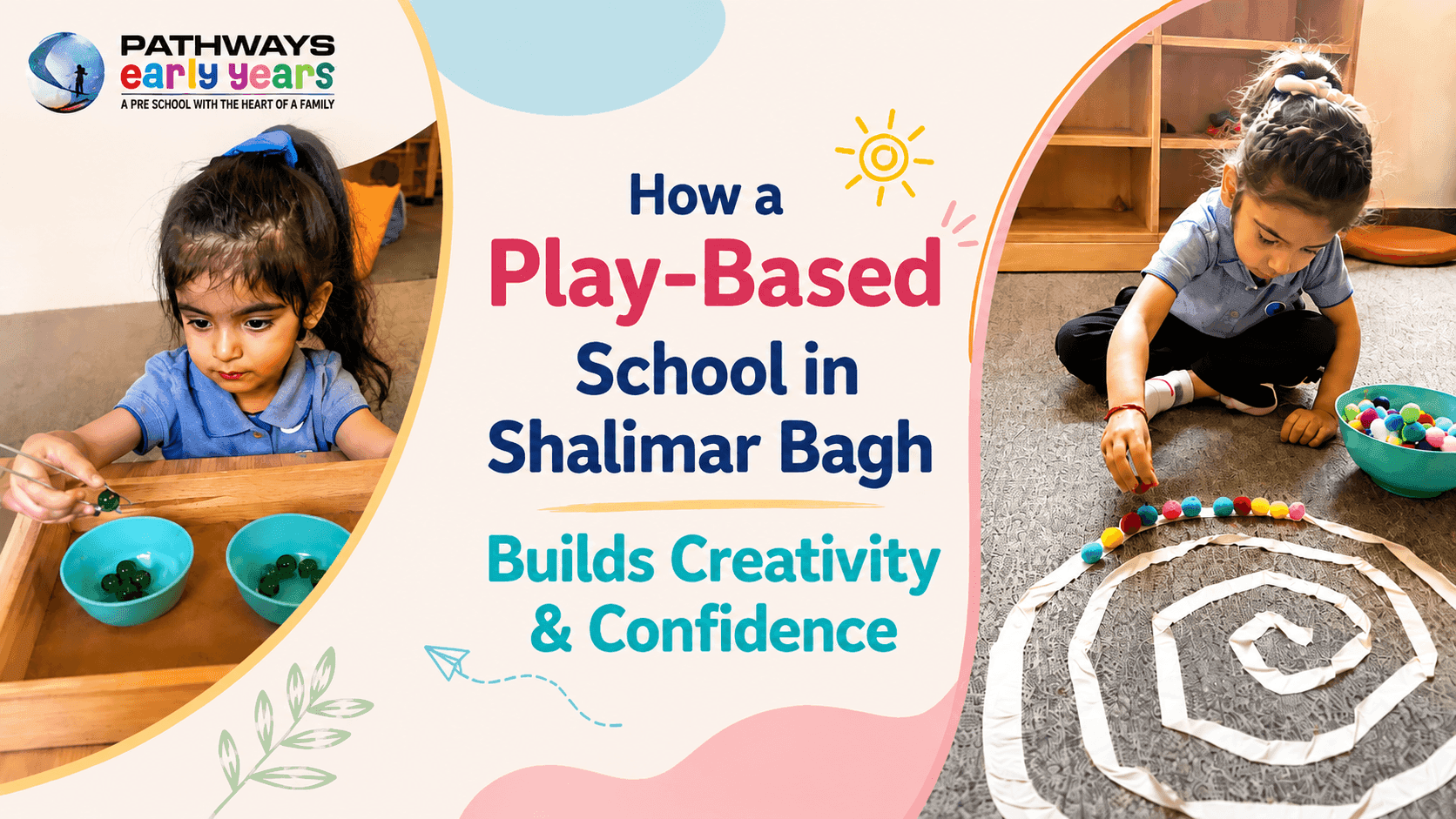
Worried your child's preschool is 'just play'? Here's how play-based learning at a school like Pathways Early Years in Shalimar Bagh quietly builds real creativity, confidence, and social skills — one game, story, and mess at a time.
Many parents wonder whether their preschooler is spending the day "just playing" instead of learning something meaningful. It's a fair question, especially in the early years when so much depends on how a child's brain and personality begin to take shape. Creativity and confidence aren't skills children pick up from worksheets — they grow through exploration, choice, and encouragement.
This is exactly where a play based learning school in Shalimar Bagh like Pathways Early Years can make a real difference. Rather than pushing rote memorisation, play-based classrooms are built around activities that let children think, imagine, and try things on their own terms. Here's what play-based learning looks like, how it nurtures creativity and confidence, what a typical day involves, and what to look for when choosing a preschool in the Shalimar Bagh area.
What Is Play-Based Learning?
Play-based learning is an early childhood education approach in which children learn concepts and skills through guided, hands-on play rather than direct instruction. Instead of sitting through lectures or repetitive drills, children explore materials, ask questions, and solve small problems as part of everyday activities like building, pretending, drawing, or storytelling.
This differs from traditional, instruction-heavy learning in one key way: the child is an active participant, not a passive listener. A teacher might introduce counting through a game involving blocks rather than a worksheet, or teach cooperation through a group activity rather than a lecture on sharing.
Play matters in early childhood because it mirrors how young children naturally process the world. When a child stacks blocks, negotiates roles in pretend play, or experiments with paint, they practise memory, language, coordination, and emotional regulation — all at once, without realising it. This is why early childhood education in Shalimar Bagh is increasingly shifting toward child-centered, activity-rich classrooms.
How Play-Based Learning Builds Creativity
Creativity in young children isn't about producing polished artwork — it's about the ability to generate ideas, make connections, and approach problems in more than one way. Play-based classrooms build this ability through several kinds of everyday activities.
Pretend and imaginative play. When a child turns a cardboard box into a spaceship or plays "shopkeeper" with friends, they invent scenarios, assign roles, and improvise dialogue — strengthening flexible thinking and storytelling ability.
Art and craft. Open-ended art activities, where there's no single "correct" outcome, let children experiment with colour, texture, and form, building comfort with trial and error.
Storytelling. Whether listening to a story or making one up, children learn to sequence events, build narratives, and express emotions through words and gestures.
Music and movement. Rhythm, dance, and simple instruments help children express feelings non-verbally and experiment with pattern and repetition.
Building and construction activities. Blocks, puzzles, and stacking toys let children test ideas physically. If a tower falls, they naturally adjust and try again — an early form of design thinking.
Open-ended activities. Materials like sand, water, clay, or loose parts (buttons, fabric, sticks) have no fixed "right" way to be used, encouraging children to invent their own approaches.
Problem-solving games. Simple games, sorting tasks, and matching activities encourage children to test different solutions rather than follow one set method.
Together, these experiences reflect what learning through play is really about: giving children repeated, low-pressure opportunities to generate and test their own ideas.
How Play Builds Confidence in Young Children
Confidence in early childhood develops gradually, through small, repeated experiences of trying, struggling, and trying again without harsh judgment. Play-based environments are structured to create exactly these moments.
Children build confidence when they are able to:
Make independent choices, such as picking an activity, a toy, or a play partner
Express ideas through drawing, talking, or pretend play, without being corrected constantly
Communicate with peers, negotiating roles or resolving small disagreements during group play
Try new activities in a low-stakes setting where mistakes are a normal part of learning
Learn from mistakes, such as a block tower collapsing or a drawing not going as planned
Complete age-appropriate tasks, like finishing a puzzle or a simple craft, which builds a sense of accomplishment
Receive encouragement instead of pressure, so effort is valued as much as the outcome
Practical confidence building activities for kids include "show and tell" sessions, group activities where each child takes a turn leading, and open-ended play stations with no single "correct" way to participate. Over time, these low-pressure experiences help children trust their own judgment.
The Role of Teachers in Play-Based Learning
Play-based learning doesn't mean unstructured or unsupervised play — the teacher's role is central, even if less visible than traditional instruction. Trained early childhood educators shape the experience in several ways.
They observe children's interests, using them to introduce new concepts, encourage exploration by offering materials and prompts rather than fixed instructions, and ask open-ended questions ("What do you think will happen if...?") that invite children to think rather than respond.
Good educators also provide guidance without taking over — stepping in just enough to help a struggling child continue — and create safe environments for experimentation, both physically and emotionally, while supporting different learning styles.
This approach is often described as child-centered learning — the curriculum adapts to the child, rather than the child being expected to fit a rigid format.
Key Benefits of Play-Based Learning for Preschoolers
Play-based learning supports development across several interconnected areas:
Creativity – generating and exploring new ideas through open-ended activities
Confidence – trusting one's own choices and abilities through repeated small successes
Communication – expressing thoughts clearly through words, art, and play
Social skills – learning to share, take turns, and cooperate with peers
Problem-solving – testing solutions and adjusting when something doesn't work
Emotional development – recognising and managing feelings during play scenarios
Independence – making choices and completing tasks without constant direction
Motor skills – building coordination through physical, hands-on activities
Curiosity – asking questions and exploring materials without fear of being "wrong"
Collaboration – working alongside others toward a shared play goal
These benefits rarely develop in isolation. A child who feels confident enough to speak up in group play is also practising communication and social skills — which is part of why holistic development of children is a central goal of quality early education.
Why Choose a Play-Based Learning School in Shalimar Bagh?
For parents evaluating preschool education in Shalimar Bagh, the educational philosophy matters as much as the location. A play based learning school in Shalimar Bagh can offer children a strong foundation, but it helps to know what to look for when comparing options:
A safe and stimulating environment — clean, secure spaces with age-appropriate materials
Qualified and caring teachers — trained in early childhood development, not just classroom management
Age-appropriate activities — suited to a child's developmental stage
Opportunities for creative expression — regular access to art, music, storytelling, and imaginative play
Balanced indoor and outdoor play — physical activity alongside structured learning time
Social interaction — group activities that build cooperation and communication
Individualized attention — small enough staff ratios for teachers to notice each child's needs
Communication with parents — regular updates on a child's progress
A focus on holistic development — attention to emotional, social, physical, and cognitive growth
Rather than choosing a school based on marketing claims, it's worth visiting in person, observing a class in session, and asking how the school structures its play school in Shalimar Bagh curriculum day to day.
Pathways Early Years, Shalimar Bagh, located in Block AD, is one option local parents can consider. Its early years preschool programme draws on established approaches — including IB PYP, Reggio Emilia, Playway, and Montessori principles — for children from infancy through kindergarten. Families balancing work and childcare can also look at its day care or after-school programmes. As with any school, the best way to know if it's the right fit is to schedule a visit and observe a class firsthand.
What Does a Typical Play-Based Learning Day Look Like?
Parents often find it easier to evaluate a school once they understand how a day is actually structured. Schedules vary by age group and by school, but a typical play-based day might include:
Welcome and free play – children settle in and choose an activity independently
Storytelling or circle time – group listening, discussion, and language development
Creative activity – art, craft, or a hands-on project
Outdoor or physical play – movement, coordination, and energy release
Collaborative activity – a group task involving sharing, turn-taking, or teamwork
Exploration or sensory play – activities with sand, water, blocks, or other tactile materials
Reflection and goodbye – a calm wrap-up, often including sharing what was made or learned
Throughout the day, learning happens naturally as children move between activities — storytelling builds language skills, group projects build cooperation, and free play builds independence, all without feeling like formal instruction.
Conclusion
Creativity and confidence don't develop through pressure or repetition — they grow through everyday moments of exploring, choosing, and trying again. A well-run play based learning school in Shalimar Bagh gives children exactly these kinds of moments, woven naturally into storytelling, art, group activities, and outdoor play. As you evaluate early education options, look beyond marketing claims and focus on the environment, the teachers, and how genuinely child-centered the daily activities are. If you're exploring options nearby, Pathways Early Years in Shalimar Bagh is worth a visit to see this kind of play-based approach in action. The right early learning experience can shape not just what a child knows, but how confidently they approach learning for years to come.
Want to see a play-based classroom in person? You can get in touch with Pathways Early Years, Shalimar Bagh (Block AD, Delhi NCR – 110088) at admissions.sb@pathways.in to schedule a visit or learn more about admissions.
About the Author
Pathways Early Years Team
Frequently Asked Questions
Play-based learning is an early childhood teaching approach where children learn through hands-on, guided play instead of direct instruction. Activities like pretend play, art, and building help children develop language, social, and problem-solving skills while staying engaged and motivated.
It improves creativity by giving children open-ended activities — imaginative play, art, construction — where there's no single correct outcome. This encourages them to generate their own ideas, experiment freely, and build comfort with trial and error.
Yes. It supports confidence by giving children repeated opportunities to make choices, try new activities, and complete tasks independently. Encouragement rather than correction helps children trust their own abilities and express themselves without fear of being wrong.
Yes, it's widely considered well-suited to preschool-aged children, since it aligns with how young children naturally explore and understand the world. It supports cognitive, social, emotional, and physical development simultaneously.
Common activities include pretend play, storytelling, art and craft, music and movement, block building, sensory play, and simple problem-solving games — each chosen to support language, motor skills, creativity, and social interaction.
Look for qualified teachers, age-appropriate activities, a safe environment, a balance of indoor and outdoor play, and regular communication with parents. Visiting the school and observing a class in session is often the best way to judge fit.
Traditional learning relies on direct instruction and structured lessons, while play-based learning uses hands-on, child-led activities to teach similar concepts, prioritising exploration and independent thinking over memorisation and repetition.
Get in Touch
Still have questions? Fill out the form below and our team will get back to you shortly.