
Child-Centric Preschool in Shalimar Bagh: How Parents Choose the Best
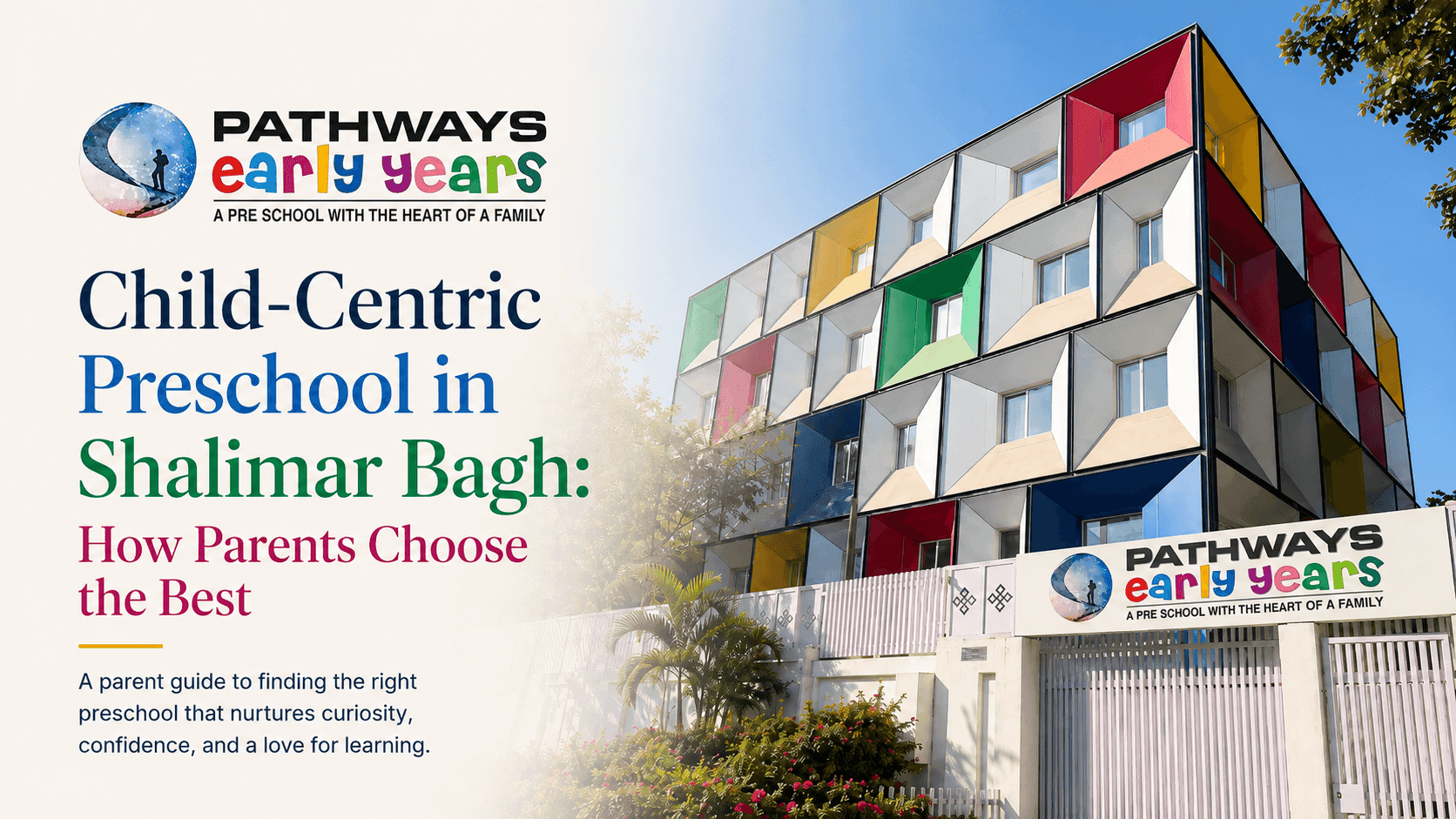
A great preschool does more than teach ABCs. See what parents should look for in a child-centric preschool in Shalimar Bagh, Delhi—from play-based learning and safety to teachers, curriculum and holistic growth.
For most toddlers in Shalimar Bagh, preschool is the first place outside home where they're expected to communicate, share, and manage their feelings without a parent close by. That shift matters more than it looks from the outside. Parents often walk in noticing the paint on the walls or the size of the play area, then realise what they actually want to know is simpler: will their child feel safe, will someone notice if they're struggling, and will they enjoy being there.
A child-centric preschool is built around exactly this question. Instead of asking children to adapt entirely to a fixed routine, it shapes early learning around how young children naturally grow, explore, and connect with others. This guide looks at what that approach means in practice, and how parents in Shalimar Bagh can evaluate a child-centric preschool in Delhi before choosing one for their child.
What Does a Child-Centric Preschool Actually Mean?
A child-centric preschool is one where teaching decisions start from the child rather than a fixed curriculum. Lesson plans and daily routines are shaped around each child's developmental stage, interests, and pace, instead of expecting every child to reach the same milestone on the same day.
So what makes a preschool child-centric in practice? It usually comes down to how much room children have to ask questions, move at their own pace, and be genuinely observed rather than simply managed. A worksheet-heavy classroom can still be caring, but a child-centric one pays closer attention to how each child is actually experiencing an activity — curious, confident, or hesitant — and adjusts accordingly.
Why Child-Centric Early Education Matters
The benefits of child-centric preschool education tend to show up less in test scores and more in how a child approaches new situations. Encouraged to explore at their own pace, children generally build confidence gradually, get real chances to make small decisions — which activity to try, how to settle a disagreement — and develop curiosity, communication, and creativity alongside this freedom to question and experiment.
None of this means one teaching method guarantees later academic performance; children develop differently, and many factors shape a school journey. What child-centric early education does support consistently is school readiness in a broader sense — a child who can listen, express themselves, manage small frustrations, and enjoy learning.
What Parents Should Look for in a Child-Centric Preschool in Shalimar Bagh
Once the general idea is clear, the next step is knowing what to check when evaluating a child-centric preschool in Delhi — and specifically here in Shalimar Bagh.
A Play-Based and Experiential Curriculum
In a play-based preschool in Delhi, learning is built into activities children already enjoy — storytelling, music, movement, art, and role play — rather than delivered separately from it. A child sorting blocks by colour is practising early maths; one narrating a pretend tea party is practising language.
Look for an activity-based learning preschool where hands-on, experiential learning happens daily, not occasionally, with children exploring materials and making their own small discoveries rather than only watching a teacher demonstrate.
Individual Attention and Personalized Learning
Children in the same age group can differ widely in how they communicate, move, or handle new situations, and a good preschool accounts for this without treating any child as behind. Personalised attention doesn't mean one-to-one teaching for every activity — it means teachers watch closely enough to notice each child's pace.
A preschool with personalized learning tracks small details, like how a child holds a crayon or joins group play, and adjusts support within everyday group activities.
Qualified, Warm and Observant Teachers
Teaching quality is often easier to observe than to ask about directly. Notice whether teachers get down to a child's eye level when speaking, and whether their tone stays warm even while redirecting behaviour.
Watch how a teacher handles a disagreement between two children. Do they listen calmly to both sides, or just issue a quick instruction? Are children encouraged to ask questions, or expected to stay quiet? These moments usually reveal more than a brochure can.
Safe and Child-Friendly Environment
A safe preschool in Delhi should explain its entry and exit protocols clearly, including how authorised pickup is verified. It's worth asking directly rather than assuming this is handled.
Beyond entry procedures, check whether classrooms and furniture are child-safe, washrooms are clean, and outdoor play areas stay supervised at all times — most schools are happy to explain their emergency preparedness when asked.
Social and Emotional Development
Much of what happens in a strong preschool classroom has little to do with letters or numbers. Children are learning to share, take turns, and manage frustration when things don't go their way — skills that take repeated practice, not a single lesson.
A classroom that supports social and emotional development gives children language for their feelings and treats small conflicts as learning moments, not problems to shut down quickly.
A Healthy Balance Between Structure and Freedom
Young children generally do well with a predictable daily rhythm — arrival, circle time, activities, outdoor play, rest — because routine helps them feel secure. Within that structure, there should still be genuine room for free play, quiet time, and child-led exploration.
A classroom that's too rigid can leave little space for curiosity, while one with no structure can leave children feeling unsettled. The most workable environments combine guided learning with unstructured time.
What Should a Good Preschool Curriculum Include?
A well-rounded child-centric preschool curriculum in Delhi — sometimes called an early years programme — typically covers several developmental areas together rather than treating them as separate subjects:
Language and communication, through conversation, stories, and songs
Early literacy and numeracy, introduced through games, patterns, and everyday objects rather than repetitive worksheets
Physical development, including fine motor skills like holding a pencil or using scissors, and gross motor skills like running or climbing
Creative expression through art, music, and imaginative play
Environmental awareness, such as noticing plants, seasons, or daily routines
Social development, emotional regulation, problem-solving, and self-help skills like washing hands or tidying up
Early literacy and numeracy matter, but at this age they work best woven into hands-on activities. A child counting snacks at the table absorbs early numeracy just as effectively as one filling in a worksheet — often more so, because the learning stays connected to something real.
Questions Parents Should Ask During a Preschool Visit
A few direct questions can reveal more about a school than any brochure. During a visit, consider asking:
What is the school's approach to early childhood learning?
How much time is devoted to free play each day?
How are children supported when they feel shy or anxious?
What is the adult-to-child ratio in each classroom?
How does the school communicate a child's progress to parents?
How are behavioural challenges typically handled?
What safety and pickup procedures are followed?
How much outdoor or physical activity do children get daily?
Are screens used in the classroom, and if so, how and why?
How does the school prepare children for primary school without adding academic pressure?
How are differences in learning pace handled within a group?
Can parents observe a classroom or speak with teachers before admission?
There's no single "correct" answer, but a school that responds clearly and specifically is usually more transparent than one offering only general reassurance.
Red Flags Parents Should Not Ignore
A few patterns are worth pausing on, even though no single one alone should cause alarm:
Heavy reliance on worksheets for very young children
Children expected to sit still for long stretches with little movement
Very limited opportunities for free play
Teachers who rarely engage warmly with children during the visit
Vague or evasive answers about safety procedures
Shouting or shaming used to manage behaviour
No clear system for regular parent communication
Strong emphasis on early writing or memorisation over exploration
Facilities that appear poorly maintained or not age-appropriate
High-pressure admission tactics or unrealistic promises
Difficulty explaining the school's teaching philosophy in plain language
A pattern of several together is worth taking seriously, even when no single sign is alarming on its own.
How Location Matters When Choosing a Preschool in Shalimar Bagh
For a two- or three-year-old, even a short car ride can feel long, which is why proximity is a practical factor, not just a convenience. A preschool close to home in Shalimar Bagh generally means less travel fatigue for a child already adjusting to a new environment.
Nearby schools also make pickup and drop simpler for parents balancing work, and allow faster access if a child needs to be collected urgently. Choosing a child-centric preschool in Shalimarbagh often means weighing curriculum and teaching quality against practicalities like these, and families across North and North-West Delhi often find that familiar neighbourhood surroundings ease the transition to preschool.
Child-Centric Preschool vs Traditional Preschool: What Is the Difference?
"Child-centric" and "traditional" describe a spectrum rather than two completely separate categories, but the table below outlines the general differences:
Child-Centric Approach | More Traditional Approach |
|---|---|
Learning through play and exploration | More teacher-directed instruction |
Child's pace considered | Same pace often used for the group |
Questions encouraged | Correct answers emphasised |
Focus on overall development | Greater emphasis on academic output |
Observation-led assessment | Worksheet or test-led assessment |
Flexible learning experiences | More fixed activities |
In practice, many good schools sit somewhere between these columns, combining structured teaching with child-centric methods. Parents are usually better served by observing how a school actually teaches than by relying on the label it uses.
How Parents Can Shortlist the Best Preschool in Delhi
With several preschools to consider, it helps to evaluate each one against the same factors rather than being swayed by whichever made the strongest first impression:
Teaching philosophy and how clearly it's explained
Teacher warmth, experience, and classroom presence
Curriculum balance across developmental areas
Safety procedures and facility upkeep
How the child behaves and reacts during the visit
Quality and frequency of parent communication
Distance and daily commute
Classroom environment and materials
Daily routine and balance of structure and free play
Willingness to build an ongoing parent-school partnership
The best preschool in Shalimarbagh for a particular family isn't automatically the one with the largest campus or the highest fees. It's the one that fits a child's temperament and developmental needs, which looks different for every family.
A Simple Preschool Visit Checklist for Parents
Before finalising a decision, run through a short checklist during or after each visit:
Children appear comfortable and engaged, not anxious or overly quiet
Teachers communicate calmly and respectfully
Classroom materials are age-appropriate and accessible to children
Play is a visible part of the daily schedule, not an afterthought
Children have room to move and explore safely
Safety and pickup policies are explained clearly
Washrooms are clean and child-friendly
Parents receive regular, meaningful communication about their child
The curriculum supports multiple areas of development, not just academics
Questions from parents are welcomed, not brushed aside
Admission staff avoid unrealistic promises or high-pressure tactics
Final Thoughts
Finding a child-centric preschool in Delhi, particularly in a neighbourhood like Shalimar Bagh, comes down to more than infrastructure, fees, or marketing claims. It's about whether a child feels comfortable enough to be themselves, whether the learning approach respects their pace, and whether teachers are warm and consistent.
Safety, play, and holistic development matter as much as any curriculum document, and ongoing parent-school communication often determines how smoothly the first few months go. No single visit will answer every question, which is why comparing a few schools against the same criteria tends to lead to a more confident decision than choosing on first impressions alone.
The right preschool is simply the one that fits your child, not the one with the most impressive brochure.
Parents considering preschool admissions in Shalimar Bagh can schedule a visit to the preschool campus, observe the learning environment, and speak with the early-years team before making a final decision.
Frequently Asked Questions
A child-centric preschool adapts teaching to each child's developmental stage, pace, and interests, rather than expecting every child to progress identically. Activities are built around how young children learn best — through play, conversation, and hands-on exploration — with teachers observing closely and adjusting support for each child.
A few signs point to a genuinely child-centric approach: teachers observe more than they instruct, questions are encouraged rather than discouraged, free play has real time in the daily schedule, and each child's pace is respected instead of being measured against one fixed timeline for every skill.
Start by understanding the school's teaching philosophy, then observe a classroom in session if possible. Look closely at teacher-child interaction, safety procedures, and how much of the day involves genuine play and exploration. Comparing a few schools against the same criteria makes the decision easier than judging each one in isolation.
Beyond curriculum and safety, consider proximity, since a shorter commute reduces travel fatigue for young children. Visit during school hours, observe teacher-child interaction directly, and ask about communication practices, adult-to-child ratios, and how the school supports children who need extra time settling in.
Yes. Play is how young children naturally practise language, problem-solving, and social skills, so play-based learning isn't separate from academic development — it's often how early concepts like counting or letter recognition are introduced in age-appropriate ways.
Get in Touch
Still have questions? Fill out the form below and our team will get back to you shortly.