
A Day at Preschool: What Does a Healthy Daily Routine Look Like for Young Children?
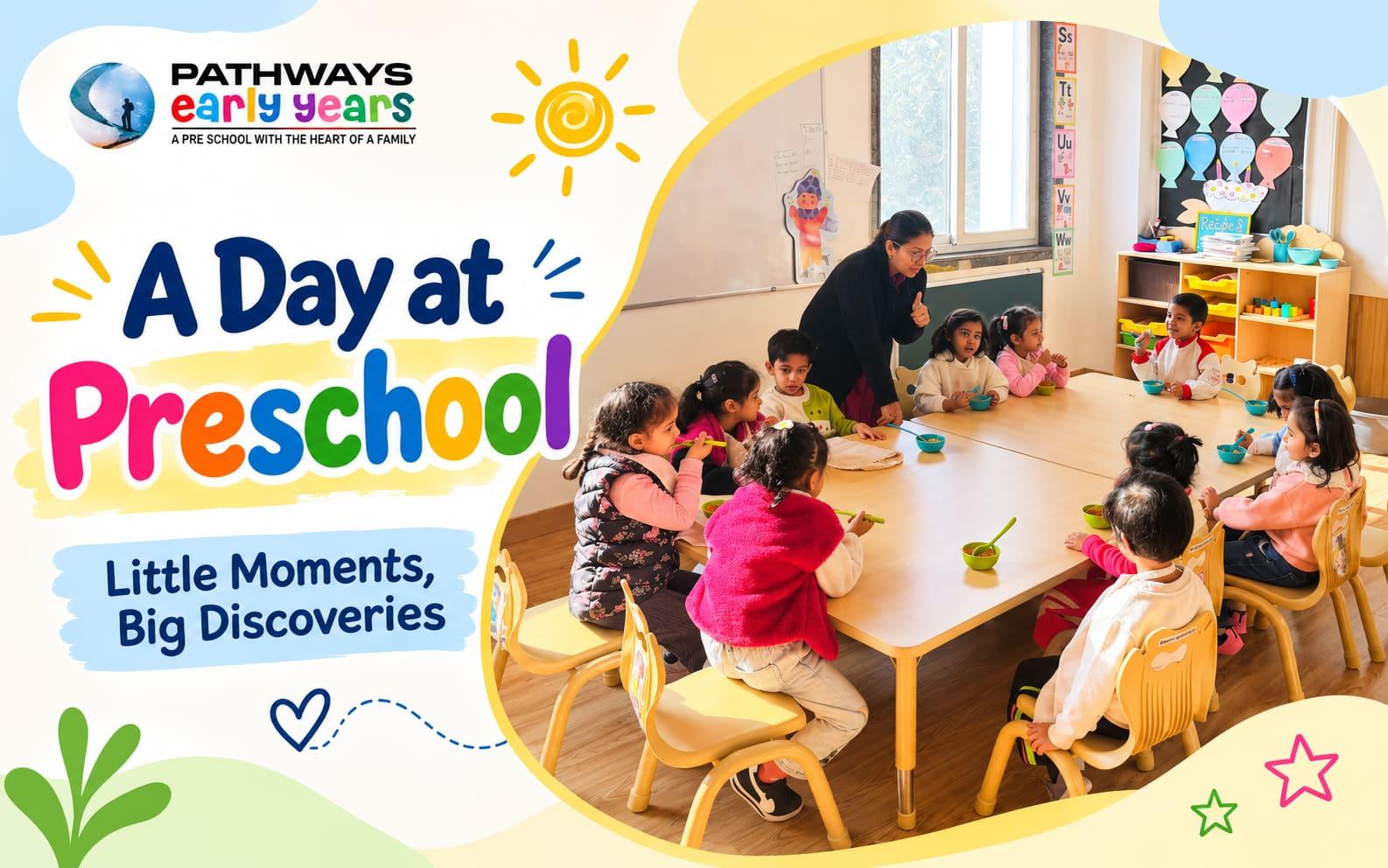
A healthy preschool daily routine blends a warm welcome, circle time, learning, free play, outdoor movement, meals, rest and co-curricular activities. This predictable rhythm helps children feel secure, learn well and build social skills.
A good preschool daily routine is not a mini school timetable. It is a calm, predictable rhythm: a warm welcome, a short group activity, hands-on learning, plenty of movement, a proper meal and time to rest. Parents often ask what really happens between drop-off and pick-up, and whether the day is mostly play or mostly lessons. At this age, the two are woven together. Children between two and six learn by touching, moving, talking and pretending, so a healthy day is built around those habits. Below you will find a sample schedule, the activities inside it, the role of co-curricular activities and the signs of a well-balanced day, so you can judge any preschool with confidence.
Key Takeaways
- Predictability builds security. A steady daily routine for preschool children shows them what comes next, which reduces anxiety and meltdowns.
- Balance is the goal. A healthy preschool daily schedule mixes structured learning, free play, movement, meals and rest.
- Play is learning. Most preschool classroom activities, such as painting, counting with blocks and singing, build language, early maths and fine motor skills.
- Outdoor time matters. Daily outdoor play develops gross motor skills, stamina and a settled mood.
- Co-curricular activities add depth. Music, dance, art and storytelling build confidence, creativity and teamwork beyond the core curriculum.
- Rhythm beats rigidity. The best routines follow a flow, not a strict clock, and adjust to each child's energy.
What Does a Typical Preschool Daily Routine Look Like?
A typical day at preschool follows a repeating pattern: arrival, circle time, learning activities, snack, outdoor play, creative time, story and goodbye. At Pathways Early Years Shalimar Bagh, programmes run four to four and a half hours a day, depending on age. Each block usually lasts 20 to 40 minutes, which matches what young attention spans can handle.
Three ideas sit behind every well-planned day:
- Predictable order. The sequence stays the same, so children feel in control.
- Short blocks. A three-year-old cannot sit still for an hour, and good teachers do not ask for it.
- Active, then calm. Running is followed by a story, and messy art is followed by a snack.
Play-based programmes, such as the preschool programme at Pathways Early Years, are built around this kind of rhythm. Its curriculum draws on the IB Primary Years Programme and is inspired by Reggio Emilia, Playway and Montessori approaches.
A Sample Preschool Daily Schedule, Step by Step
This sample daily routine for preschool children shows how the pieces fit together. Timings are illustrative only, so this table shows the general order of a day, not clock times or any one school's timetable.
| Step | Activity | What it builds |
|---|---|---|
| 1 | Arrival and welcome | Emotional security, independence |
| 2 | Circle time | Listening, language, sense of routine |
| 3 | Learning activities | Early literacy, numeracy, fine motor skills |
| 4 | Snack and handwashing | Self-help skills, healthy habits |
| 5 | Outdoor play | Gross motor skills, teamwork |
| 6 | Creative and co-curricular time | Imagination, self-expression |
| 7 | Story time and reflection | Vocabulary, calm focus |
| 8 | Goodbye circle | Closure, confidence |
Longer programmes usually add a meal and a rest period.
Preschool Daily Activities That Fill the Day
Preschool daily activities fall into a few groups, and each one supports a different part of development.
Circle time and language
Circle time opens the day. Children sing, greet one another, talk about the weather and hear a short story. It builds listening, vocabulary and the confidence to speak in a group.
Preschool classroom activities
Preschool classroom activities at Pathways Early Years Shalimar Bagh, as listed on its website under Happy Learning Through Play, include:
- Creative play: painting, drawing and crafting to spark imagination
- Early math fun: learning numbers with toys, blocks and games
- Music and movement: dancing, singing and joyful movement every day
- Friends and sharing: building friendships through play and teamwork
- Hands-on activities woven into the daily routine to develop gross and fine motor coordination
Snack, rest and self-care
Snack and rest time are part of the curriculum. Washing hands, opening a tiffin box and tidying up all teach independence. Younger children also need quiet time, either a nap or a calm corner with soft toys and books.
Indoor and Outdoor Activities for Preschoolers
Children need both, and a healthy day alternates between them.
- Indoor activities build focus and fine control: puzzles, clay, story circles, music with simple instruments, art and easy science play such as floating and sinking.
- Outdoor activities use big muscles and big energy: running, climbing, ball games, sandpit play, gardening and nature walks.
Outdoor play does more than burn energy. It improves balance and coordination, helps children sleep better and gives them real practice at taking turns and settling small disagreements. When heat, rain or poor air quality keep children inside, good schools swap in indoor movement such as dance, yoga stretches or a simple obstacle course.
How Schools Balance Learning and Play in a Preschool Daily Routine
The balance question worries many parents. In practice, learning and play are not two separate blocks. A good preschool daily routine blends three modes:
- Child-led play. Children pick materials and follow their curiosity while teachers observe and ask questions.
- Teacher-guided activities. Short, planned sessions teach one skill at a time, such as letter sounds, counting to ten or cutting along a line.
- Routines and transitions. Tidy-up songs, lining up and handwashing build habits and independence.
A simple test helps. If children spend most of the day at desks with worksheets, the day has tipped too far towards formal work. If every minute is unstructured, they may miss guided practice in language and early numeracy. Look for a day where the teacher's plan is visible, yet the children seem to be enjoying every part of it.
Co-Curricular Activities for Preschool Children
What counts as co-curricular in preschool?
Co-curricular activities for preschool children are the creative and physical experiences that sit alongside the core learning programme. Common examples are music and singing, dance, art and craft, storytelling, simple yoga, games and show-and-tell. Some schools also offer an after-school programme for children who want more time to explore.
Why are co-curricular activities important in early childhood?
The importance of co-curricular activities in preschool lies in the skills they build that worksheets cannot:
- Confidence. Performing a song or showing a drawing teaches children that their voice matters.
- Social skills. Group dance, shared art tables and team games teach turn-taking and cooperation.
- Motor development. Dance, games and craft train both large and small muscle control.
- Language and memory. Rhymes, rhythm and storytelling strengthen vocabulary and recall.
- Emotional expression. Art and music give children a safe way to show feelings they cannot yet put into words.
Children also discover what they enjoy, which makes school a place they want to return to. Pathways Early Years, for example, features a dance performance, a doctor visit and a summer camp in its photo gallery, which links to its events page, giving parents a window into this side of the day.
What Should a Healthy Preschool Daily Schedule Include?
Use this checklist when you compare schools or plan a routine at home:
- A calm, welcoming arrival
- A group circle with songs and conversation
- Guided learning in short blocks
- Free play with open-ended materials
- Outdoor movement every day
- Snack or lunch with handwashing
- Quiet rest or a calm activity
- Creative or co-curricular time
How does a daily routine support child development?
Routine works like scaffolding. Children who know what comes next spend less energy worrying and more energy exploring. A steady routine:
- Supports emotional development by building trust and easing separation anxiety.
- Strengthens language through repeated songs, greetings and instructions.
- Builds self-regulation, because children practise waiting, sharing and switching between activities.
- Improves school readiness, including following instructions and working in a group.
Full-day settings such as day care need extra attention to meals and rest, but the same principle holds: keep the day predictable, gentle and balanced.
Conclusion
A healthy preschool daily routine gives young children what they need most: predictability, play, movement, rest and room to be creative. When the day flows from circle time to learning centres, outdoor play and co-curricular activities, children build skills without feeling pushed. As you compare schools, watch the rhythm of the day as closely as the curriculum. Families in Shalimar Bagh who want to see this kind of day in action can contact Pathways Early Years to enquire about admissions and plan a visit.
Frequently Asked Questions
A typical day moves from arrival and circle time to learning centres, snack, outdoor play, creative activities, story time and goodbye. Blocks last 20 to 40 minutes and alternate between active and calm, so children stay engaged without getting overtired.
It depends on age. At Pathways Early Years Shalimar Bagh, Pre-Toddlers (18 months to 2 years) and Toddlers (2 to 3 years) attend for 4 hours, while Pre-Nursery (3 to 4 years), Nursery (4 to 5 years) and Kindergarten (5 to 6 years) attend for 4.5 hours. Watch your child's mood and sleep in the first few weeks and tell the teacher if the length needs adjusting.
There is no fixed ratio, because at this age play is learning. Look for a day that includes child-led play and short teacher-guided sessions, with most time spent on hands-on activity rather than seated worksheets.
Most routines include circle time, rhymes and stories, art and craft, blocks and puzzles, pretend play, sensory activities, music and movement, outdoor play and snack time. Co-curricular options such as dance or storytelling are layered in through the week.
They build confidence, social skills, motor control, language and emotional expression. A child who sings in a group or shares a painting also practises listening, turn-taking and speaking up, which supports everyday classroom learning.
They are not compulsory, but they are valuable. Early childhood is when children discover interests and learn to express themselves. Light, playful sessions in music, art or movement add variety and help shy children join in. Pressure to perform is best avoided.
Keep fixed times for waking, meals, play and sleep, and use simple cues such as a song before tidy-up. Include one outdoor session, one creative activity and one story each day. Consistency matters more than perfection.
Check for a clear daily rhythm, enough outdoor and free play, calm rest for younger children and visible co-curricular activities. Ask to see classrooms in use and notice how teachers speak to children. A relaxed, warm atmosphere is a good sign.
Get in Touch
Still have questions? Fill out the form below and our team will get back to you shortly.