
Understanding Kindergarten Education in India: Meaning, Stages and Learning
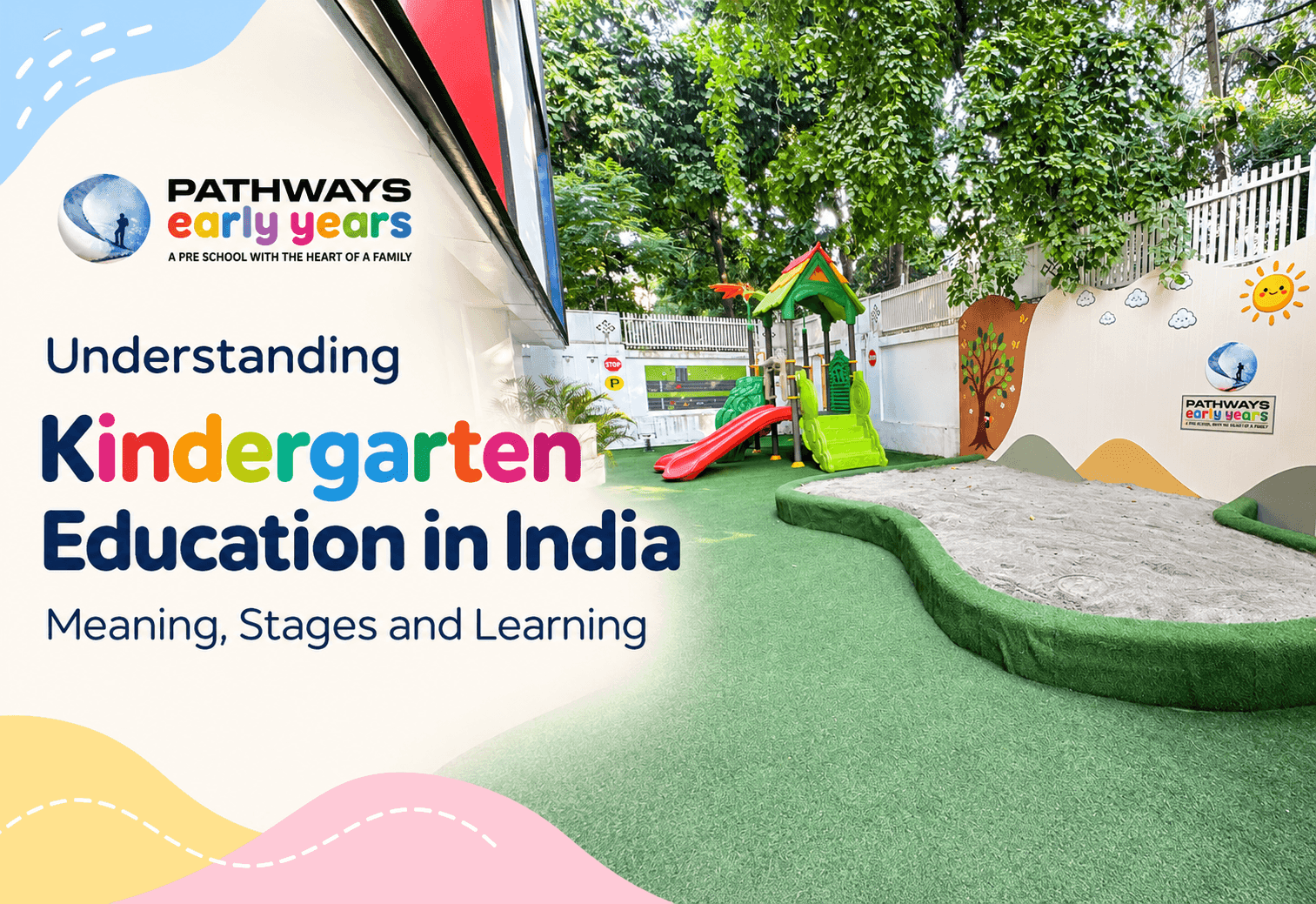
What is kindergarten education in India? Learn the meaning, stages, curriculum and what children learn, plus tips to choose the right school.
Kindergarten education in India is the early schooling stage for children aged roughly 4 to 6 years. It builds language, thinking, social and emotional skills through play, stories, music and hands-on activities before formal primary school begins.
If you are asking what is kindergarten, the word comes from German and means "children's garden". The idea is that young children, like plants, grow best with care, light and room to explore. In India, most families know it as LKG and UKG, though schools use the term in slightly different ways.
This guide explains the meaning of kindergarten in India, the stages, how the system works, what children learn and how to choose a good school. It is written to help you decide with confidence, not to rush your child.
Key Takeaways
- Kindergarten is the stage between preschool and primary school, usually for ages 4 to 6.
- Good kindergarten education is built on play-based learning, not early pressure or heavy homework.
- Children grow in language, early maths, social and emotional skills, thinking and movement.
- Names and age bands differ between schools, so always ask how a school defines each stage.
- Choose a school by its teachers, daily routine and care for your child, not only by its name.
What Is Kindergarten Education in India?
Kindergarten education is the structured early learning children receive just before Grade 1. It sits within early childhood education, the years when the brain develops fastest and children form habits for learning, friendship and confidence.
The meaning of kindergarten for children is simple: a safe, joyful place to learn how to learn. They listen to stories, sing, count, draw, build, share and solve small problems. The focus is on curiosity and growth, not on exams.
In India, the term is used for the pre-primary years in many schools. Some use it for only the last two years (LKG and UKG), while others use it as a broad label for the whole pre-primary programme.
Kindergarten Stages in India
Stage names vary, but a common pattern looks like this:
- Playgroup or pre-toddler: roughly 18 months to 3 years, for first experiences of group learning.
- Nursery or pre-nursery: roughly 3 to 4 years, for language, play and routines.
- LKG (lower kindergarten): roughly 4 to 5 years, for early literacy and number sense.
- UKG (upper kindergarten): roughly 5 to 6 years, for school readiness and independence.
At Pathways Early Years in Shalimar Bagh, the programmes run from Pre-Toddlers through Pre-Nursery (3 to 4 years), Nursery (4 to 5 years) and Kindergarten (5 to 6 years). If the names confuse you, our guide to the difference between preschool and nursery explains how the stages fit together.
How Does Kindergarten Education Work in India?
Kindergarten education in India does not follow one fixed national timetable for every school. Early years are outside the compulsory age range of the Right to Education Act, which covers ages 6 to 14, so age rules, fees and curriculum differ from school to school.
National policy still shapes the direction. The National Education Policy 2020 treats ages 3 to 8 as a single foundational stage, and the National Curriculum Framework for the Foundational Stage encourages play-based, activity-based learning. Many schools now follow this approach, and some draw on international ideas such as Montessori, Reggio Emilia or the IB Primary Years Programme.
Ask each school how it translates these ideas into a real day. A strong kindergarten education system shows in the classroom: children moving, talking, making and asking questions, with teachers who guide instead of lecture.
What Do Children Learn in Kindergarten?
A good kindergarten curriculum develops the whole child. It covers five connected areas, and children often learn several at once.
Language and Early Literacy
Children listen to stories, learn new words, recognise letters and sounds and begin to express ideas in sentences. Rhymes, picture books and conversation do more for early literacy than copying letters again and again.
Early Maths and Foundational Learning
Foundational learning starts with sorting, counting, comparing, patterns and shapes. Children use blocks, beads and everyday objects, so numbers feel real and not abstract.
Social and Emotional Development
Kindergarten is where children practise sharing, taking turns, listening to others and naming feelings. These skills shape friendships and make later learning easier.
Cognitive Development and Thinking
Puzzles, building, pretend play and open-ended questions help children plan, test ideas and solve problems. Our article on how play helps children develop problem-solving skills shows how simple games build this kind of thinking.
Physical Development and Creativity
Running, climbing, cutting, drawing and dancing build the strength and coordination children need for writing and for confident movement. Art and music give them ways to express ideas without words.
Play-Based and Experiential Learning
Play-based learning means children learn through activities they enjoy, guided by teachers who plan the setting and ask the right questions. Experiential learning goes one step further: children learn by doing, such as planting seeds, measuring water or running a pretend shop.
This approach is not the same as no learning. Behind every play activity sits a goal, whether it is vocabulary, counting, fine motor skills or teamwork. Children remember what they experience far better than what they only hear.
Importance of Kindergarten Education for Children
The importance of kindergarten education for children lies in the foundation it builds. Children who enjoy learning early tend to approach school with more confidence and curiosity.
- It builds school readiness, from listening and following routines to holding a pencil.
- It supports child development across language, thinking, movement and feelings.
- It teaches children to be part of a group, share and cope with small disappointments.
- It helps parents spot early strengths and needs, so support can start in good time.
If you are unsure whether your child is ready, our preschool readiness checklist gives you a gentle way to look at communication, independence and emotional readiness.
Kindergarten vs Grade 1: What Changes?
Many parents worry about the jump from kindergarten to Grade 1. The change is real but manageable. Days become more structured, children sit for longer and writing becomes a daily task.
A good kindergarten prepares children gently for this. They practise listening in a group, following two- and three-step instructions, holding a pencil, packing their own bag and asking for help. Children who have enjoyed learning usually adapt faster than those who were drilled early.
Talk to your child about big school in a positive way, visit the primary classroom if the school allows it and keep routines steady during the move.
How to Choose a Kindergarten School
A visit tells you more than a brochure. Use this simple list when you compare schools:
- Watch the classroom. Look for happy, busy children and teachers who kneel to talk with them.
- Ask about the day. A good schedule mixes play, stories, movement, rest and quiet activities.
- Check the teachers. Ask about training, experience and how many children each adult looks after.
- Look at safety and hygiene, from entry rules to clean toilets and supervision.
- Ask how the school talks to parents and shares your child's progress.
- Be wary of heavy homework or pressure to write early. It rarely helps at this age.
For more detail, read our guide on how to choose the best kindergarten school in Shalimar Bagh.
How Parents Can Support Kindergarten Learning at Home
Home matters as much as school. A few small habits make a real difference:
- Read together every day and talk about the pictures and the story.
- Count and sort everyday things, such as fruit, shoes or spoons.
- Give your child time for free play, outdoors if possible.
- Keep a steady routine for sleep, meals and school mornings.
- Praise effort and curiosity instead of only correct answers.
Conclusion: Give Your Child a Joyful Start
Kindergarten education in India is the bridge between early childhood and formal schooling. At its best, it helps children grow in language, thinking, friendship and confidence through play and hands-on discovery, so they arrive at primary school curious and ready.
Take your time, visit schools, ask questions and trust what you see in the classroom. If you would like to see how play-based kindergarten learning looks in practice, explore the Pathways preschool programmes in Shalimar Bagh and book a visit.
About the Author
Pathways Early Years Team
Frequently Asked Questions
Kindergarten is the early schooling stage just before primary school. The word means "children's garden" in German. Children learn through play, stories, songs and hands-on activities that build language, thinking, social skills and confidence.
Kindergarten in India usually covers about 4 to 6 years, often as LKG and UKG. Some schools start earlier or use different names, so check the age rule and cut-off date with each school you are considering.
No. The Right to Education Act covers ages 6 to 14, so kindergarten is not legally compulsory. Most families still choose it because it prepares children for primary school. Admission rules and fees are set by each school.
LKG is the first kindergarten year, usually around ages 4 to 5, with a focus on early language, numbers and social skills. UKG is the second year, usually around 5 to 6, and prepares children for Grade 1 with more independence.
Not exactly. Preschool often means all the years before primary school, from playgroup onwards. Kindergarten usually means the last stage of that period. Some schools use the words interchangeably, so ask how they define each one.
Children learn early language and literacy, number sense, social and emotional skills, thinking and problem-solving, and physical coordination. They also learn routines such as listening, sharing and following simple instructions, mostly through play.
Look for interest in other children, simple communication, some independence with routines and comfort with trusted adults. Perfection is not needed. If you are unsure, speak with the school or use a readiness checklist as a starting point.
Most early years experts favour play-based learning with clear learning goals, because young children learn best by doing. Look for a school that teaches letters and numbers through activities and avoids heavy homework or pressure to write early.
Get in Touch
Still have questions? Fill out the form below and our team will get back to you shortly.