
Emotional Intelligence vs Academic Skills: What Matters More in Early Childhood Education?
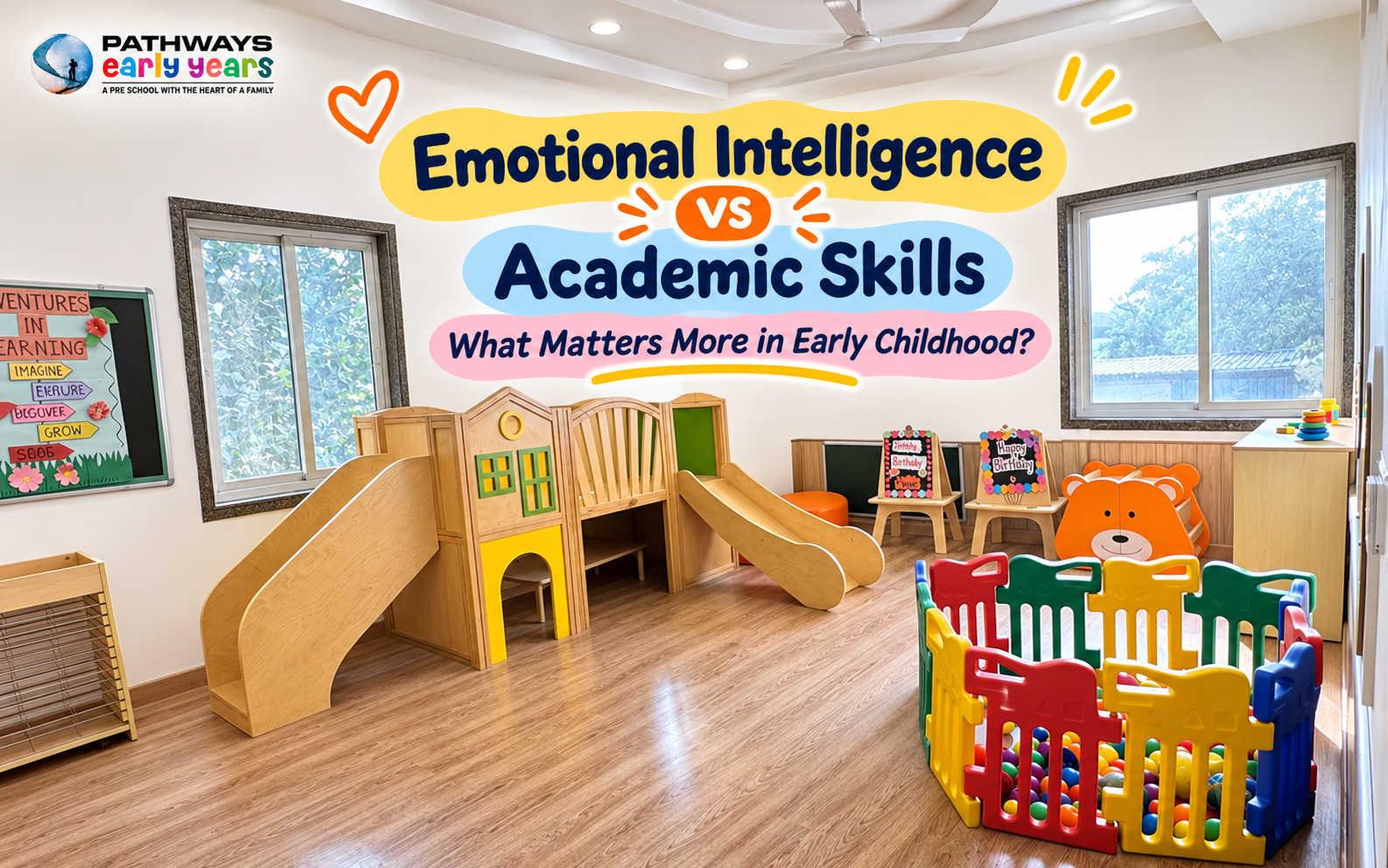
Emotional intelligence vs academic skills: which matters more in early childhood? See how both shape preschool learners and what to look for.
Parents visiting preschools often start with the same question: will my child learn to read early? It is a fair worry, and it quietly pushes a harder question aside. The debate of emotional intelligence vs academic skills is not a contest between feelings and facts. A three-year-old who cannot wait for a turn will struggle to sit through a story, while a child who feels safe will happily attempt the same puzzle ten times. Letters and numbers matter, but they land on ground that emotional skills prepare. This guide explains what each skill set means for children aged one to six, how they feed each other, and what to look for in a classroom. It also draws on how Pathways Early Years in Shalimar Bagh describes its own approach.
Key Takeaways
- Emotional skills open the door. Children who can name feelings and calm down are ready to listen, try and learn.
- Academics still count. Early language, number sense and curiosity give children the tools to use that readiness.
- The two grow together. Self-regulation, empathy and communication skills support cognitive development every day.
- Play is the bridge. Music, building, pretend games and shared tasks teach feelings and concepts in one go.
- Watch behaviour, not worksheets. How a child handles frustration says more about school readiness than reciting the alphabet.
- Choose balance in a preschool. Look for small groups, warm adults and learning that is hands-on rather than rushed.
- Home habits matter. Talking about feelings at bedtime or in the car builds the same skills a good classroom does.
What Emotional Intelligence and Academic Skills Mean for Young Children
Emotional intelligence in the early years
Emotional intelligence is the ability to recognise feelings, manage them and respond to other people kindly. In a preschooler, that looks small and concrete: saying "I am angry" instead of throwing a block, hugging a friend who is crying, or asking for help when a shoe will not go on. Empathy, self-regulation and simple communication skills sit at the centre of it.
Academic skills in the early years
Academic skills at this age are not exam skills. They are early literacy, number sense, fine motor control, listening and curiosity. Counting steps on the stairs, sorting leaves by size and spotting the first letter of a name all count. These are building blocks for later reading and maths, not a head start on homework.
Emotional Intelligence vs Academic Skills: Which Matters More at This Age?
The honest answer is that neither wins alone, but one comes first.
Why emotional skills come first
Learning needs a calm, secure child. A toddler who is anxious about separating from a parent, or who melts down when a tower falls, has little attention left for new ideas. Once a child feels safe and can recover from small disappointments, the same child can follow a story, manage a two-step instruction and stay with a hard task for a few more minutes.
Why academics still count
A child with strong feelings skills but little exposure to words, numbers or books will meet primary school at a disadvantage. Early academics give confidence somewhere to go. When a child can count a handful of blocks or retell a story, pride follows, and pride feeds the emotional side. So the question of emotional intelligence vs academic skills is better answered as a sequence than a ranking: feelings first, then facts, then both together.
Emotional Development vs Academic Development: How They Work Together
Self-regulation fuels attention
Waiting, sharing and stopping a game when asked are all self-regulation. The same muscle is used to sit through circle time or finish a drawing.
Empathy and communication build language
Children who want to understand a friend ask more questions, listen more closely and use more words. That conversation is early literacy in disguise, and it sharpens communication skills.
Problem-solving connects both
Working out how to share one set of paints takes negotiation, which is emotional, and logic, which is cognitive. Problem-solving is where cognitive development and feelings meet, and a holistic child development approach treats them as one thread.
Social Emotional Learning in Preschool: What It Looks Like in a Classroom
Social emotional learning in preschool rarely arrives as a lesson titled "feelings". It happens inside ordinary activities. At Pathways Early Years in Shalimar Bagh, the preschool programme runs for children from 12 months to six years, in five stages from Pre-Toddlers to Kindergarten. The school says its Pre-Toddler stage focuses on security, belonging and trust, using sensory exploration, movement, music and responsive interactions, with learning that is child-led and experiential.
The wider curriculum draws on the school's experience with the IB Primary Years Programme and is inspired by Reggio Emilia, Playway and Montessori approaches. Its website also notes that a small school size allows personalised care, and that the programme supports academic, social and emotional well-being together.
Day to day, the homepage lists creative play, early math with toys, blocks and games, music and movement, and friendships built through play and teamwork. Notice the mix: painting and number games sit beside sharing and teamwork. That is the balance this article argues for.
Why Emotional Intelligence Is Important in Early Childhood Education
The importance of emotional intelligence in children shows up in three places: friendships, classroom behaviour and later resilience. Children who read feelings well find it easier to join a game and settle a disagreement. Teachers can spend more time teaching and less time managing distress. And a child who has practised handling disappointment at four is better placed to handle a hard maths problem at eight. None of this removes the need for strong teaching. It explains why the early years put relationships before results.
Balancing Emotional Intelligence vs Academic Skills at Home
You do not need flashcards or a feelings chart. Small, steady habits work.
- Name feelings out loud. "You look disappointed that the park is closed" gives a child the word they lack.
- Read together daily. Ask what a character feels before asking what happens next.
- Count and sort in routines. Socks, spoons and stairs all work.
- Allow a short struggle. Let children try a puzzle or a button before you step in.
- Praise specifically. Notice effort and kindness, not only right answers.
Choosing a Preschool: Emotional Intelligence vs Academic Skills Checklist
Visit before you decide, and watch rather than listen. Use this checklist on your tour:
- Do teachers get down to a child's level and respond when a child is upset?
- Is the day mixed, with play, music, art and early number or letter work?
- Are groups small enough for adults to know each child?
- Do children take turns and solve small conflicts with adult guidance?
- Is there regular, open communication with parents?
Working parents may also want longer hours. The Pathways day care page describes age-appropriate groups, physical education, music, dance, visual arts and drama, nourishing meals and rest, and regular parent-teacher meetings.
Beyond daily classroom routines, community events provide another meaningful opportunity for children to build confidence and social skills. The school's events page lists a Summer Camp, Deep Utsav and a Christmas Carnival, where children practice cooperation in joyful settings.
Seeing a classroom in session is often the clearest way to evaluate how teachers support emotional and cognitive growth. To see a classroom yourself, contact the admissions team.
Conclusion
Emotional intelligence vs academic skills is the wrong fight for a four-year-old, because each one carries the other. The practical answer to emotional skills vs academic skills in preschoolers is a sequence: safety and self-control first, curiosity and early literacy built on top, and play connecting the two. When you tour a school, watch how adults respond to a child who is upset and how they invite a child to try something hard. Those two moments tell you more than any brochure. If you want to see how a small, play-based preschool approaches both, visit Pathways Early Years in Shalimar Bagh.
Frequently Asked Questions
Emotional skills usually come first, because a calm, secure child can pay attention. Academic skills follow quickly once that base is in place, and the best programmes teach both through play rather than separately.
From infancy. Babies learn trust through responsive adults. By two or three, children can begin naming simple feelings, and by four or five they can take turns, wait and talk through small conflicts with help.
A toddler may name or point to feelings, accept comfort, notice when another child is upset and recover from a small disappointment within a few minutes. Every child grows at their own pace, so look for progress, not perfection.
No. Emotional development vs academic development is not a trade-off. Calmer, more confident children tend to pay attention longer, ask more questions and stay with tasks, which supports early literacy and number work.
Name feelings as they happen, read stories and discuss what characters choose, stay calm yourself, and give your child time to solve small problems. Short daily conversations work better than occasional long talks.
It means helping children recognise feelings, make friends, cooperate and handle frustration. It is taught through play, music, group activities and daily routines rather than worksheets.
Yes, when the play is well designed. Play builds language, number sense, fine motor skills and self-control, all of which primary school needs. Ask the school how play links to early reading and maths.
Visit during a normal session. Look for warm, responsive teachers, small groups, a mix of play and early learning tasks, and children who look settled and curious. Ask how staff comfort upset children and share progress with parents.
Get in Touch
Still have questions? Fill out the form below and our team will get back to you shortly.