
How Preschool Supports Overall Child Development: Key Benefits
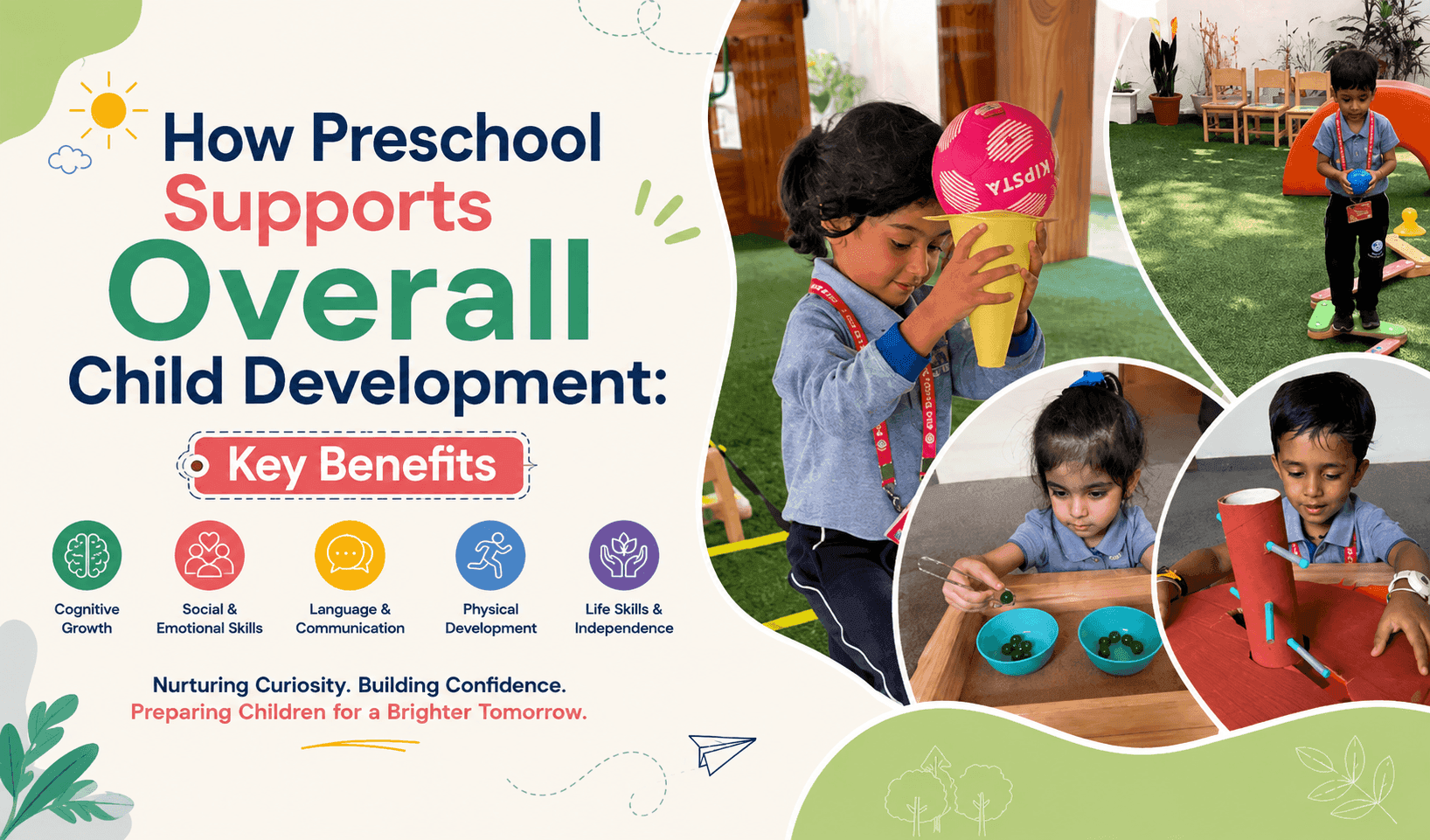
Preschool shapes more than early academics. Discover how play, friendships, routines and guided activities support your child’s cognitive, social, emotional, physical and communication development.
Many parents pause before enrolling a toddler in preschool and ask a simple question: does it really help, or is it just early academics dressed up as play? Understanding how preschool supports overall child development can ease that uncertainty. The early years, roughly from one to six, are when a child's brain forms connections faster than at any later stage of life. This is when communication, confidence, curiosity and social awareness begin to take shape.
A well-run preschool doesn't rush this process. Instead, it gives children structured, everyday opportunities to explore, ask questions, make friends and build habits that support learning for years to come. This blog looks at what that support actually looks like in a typical preschool day, and why it matters long before a child picks up a pencil.
What Does Overall Child Development Mean?
Overall child development means a child's growth across several connected areas at once, not just academic skills. In early childhood, these areas typically include:
Cognitive development – thinking, reasoning and problem-solving
Social development – interacting with others and forming relationships
Emotional development – understanding and managing feelings
Language and communication – expressing needs and ideas clearly
Physical and motor development – gross motor skills and fine motor skills
Creativity and imagination – exploring ideas through play and art
Independence and life skills – managing everyday tasks
These areas rarely grow in isolation. Building a tower of blocks, for instance, can involve concentration, conversation, patience and hand coordination all at once. Children also develop at their own pace, and a child-centred preschool programme supports this natural progression rather than pushing children toward fixed milestones. If you ever have specific concerns about your child's development, it's worth speaking with a paediatrician or early-childhood professional.
Why Preschool Is Important During the Early Years
Preschool matters during the early years because this is when a child's brain is most receptive to new experiences, relationships and routines. Understanding the importance of preschool education starts with recognising how much happens in a young mind between the ages of one and six.
During this stage, children are naturally curious and absorb new information quickly. Preschool turns that curiosity into real early childhood education benefits: guided exploration, consistent routines and regular interaction with peers and educators. Rather than leaving a child's first social and learning experiences to chance, preschool creates a safe space to practise them daily.
This is also why preschool is important for children who will soon move into formal schooling. Getting comfortable with a classroom routine, listening to instructions and spending short periods away from parents happens gradually, well before Class 1 begins.
Key Benefits of Preschool for Overall Child Development
Preschool influences far more than early academics. The sections below break down how preschool supports overall child development across ten connected areas, from thinking skills to confidence and independence, each one reinforcing the others.
1. Supports Cognitive Development
Cognitive development in preschool children refers to how they observe, remember, reason and solve problems, built gradually through everyday activity rather than formal instruction.
Puzzles, sorting games, building blocks, matching activities and simple hands-on experiments encourage children to notice patterns and test ideas. Storytelling strengthens memory and sequencing, while open-ended questions from educators nurture curiosity-led exploration and early mathematical understanding, like counting and comparing sizes.
2. Builds Language and Communication Skills
Beyond thinking skills, preschool plays a major role in language growth. Language development through preschool happens mainly through everyday conversation, and communication skills in preschool children grow as they talk, listen and are listened to in return.
Songs, stories, role play and group discussions expand vocabulary and help children form complete sentences. Classroom interactions build listening skills and speaking confidence, and lay the groundwork for early literacy awareness, without expecting preschoolers to read fluently before primary school.
3. Encourages Social Development
Alongside language, preschool nurtures social skills early on. Social and emotional development in preschool often starts with small, everyday moments: sharing a toy, waiting for a turn or joining a group activity.
With guidance from supportive educators, children learn to respect personal space, follow classroom expectations and work through small disagreements. Guided peer interaction and group activities help children build early friendships, an important step before larger school settings.
4. Strengthens Emotional Development
Closely linked to social growth is emotional development. This includes recognising feelings, expressing them appropriately and coping with frustration, and preschool offers regular, low-pressure opportunities to practise all three.
Spending short periods away from parents helps children build confidence and resilience gradually. With encouragement, children learn it's safe to ask for help in new situations. This growth develops steadily, supported by patience and consistent positive reinforcement rather than pressure.
5. Improves Physical and Motor Skills
Preschool isn't only about the mind and emotions; movement matters too. Physical development in early childhood includes gross motor skills, like running, jumping, balancing and climbing, and fine motor skills, like drawing, painting or threading beads.
Outdoor play builds strength and coordination, while handling blocks, puzzles and child-safe tools strengthens the small hand muscles children later use for writing. These skills also support everyday independence, from managing buttons to carrying their own belongings.
6. Develops Creativity and Imagination
Alongside physical activity, creative expression gets plenty of room to grow. Creativity in preschool shows up through art, music, dance, storytelling and pretend play, giving children a safe way to express ideas they may not yet have words for.
Open-ended materials, like blocks, clay or dress-up props, encourage experimentation without a fixed "right answer." Dramatic play and building activities support flexible thinking, since children constantly adjust their ideas as a story or structure develops.
7. Encourages Independence and Life Skills
As children grow more capable, preschool also builds everyday independence. Life skills development in preschool happens through small, repeated routines: organising belongings, washing hands, eating independently and following simple daily routines.
Preschool also gives children safe opportunities to make simple choices and complete age-appropriate tasks, like tidying up after an activity. Just as importantly, children learn it's okay to ask an adult for help when a task feels difficult.
8. Builds Confidence and Self-Esteem
All of this steadily builds something less tangible but just as important: confidence. It grows from small, repeated successes, not big achievements. Completing a puzzle or contributing an idea during circle time helps a child feel capable.
Positive encouragement from educators matters here. Celebrating a child's effort, curiosity and progress, rather than comparing them with classmates, helps preschoolers build genuine self-esteem within a positive learning environment.
9. Introduces Structure and Healthy Routines
None of this happens by accident; it's supported by structure. A typical preschool day follows a predictable rhythm: arrival, circle time, play-based learning, snack breaks, outdoor play, creative activities and a quiet rest period before children go home.
This structure does more than organise the day. Predictable routines help children understand what comes next, which builds emotional security and makes daily transitions feel manageable instead of stressful.
10. Prepares Children for Formal Schooling
Eventually, these skills come together to support one more goal: readiness for primary school. How preschool prepares children for school has less to do with early reading or writing and more to do with everyday school readiness, like listening to instructions, participating in groups and communicating needs to an adult who isn't a parent.
Preschool also helps children manage their own belongings, move between activities without becoming overwhelmed, and focus for age-appropriate stretches of time, alongside natural exposure to books, numbers and sounds.
The Importance of Play-Based Learning in Preschool
Play is one of the main ways young children explore and understand the world, which is why the importance of play-based learning comes up so often in early years education. Rather than sitting apart from learning, play is often how learning happens.
Preschool programmes usually include several forms of play: free play, chosen by the child; guided play, gently led by an educator; imaginative and sensory play; outdoor play; and collaborative or constructive play, like building something together. Each type supports preschool learning and development differently.
A single game of pretend shopkeeper can involve counting, conversation, turn-taking and problem-solving all at once. This is what makes well-planned preschool activities for child development so effective: they rarely target just one skill at a time.
Examples of Preschool Activities That Support Development
The table below highlights common preschool activities and the developmental areas they support, a useful starting point for understanding what's really happening behind everyday play.
Preschool Activity | Developmental Area Supported | Skills Children Practise |
|---|---|---|
Storytelling | Language, imagination, social skills | Vocabulary, sequencing, active listening |
Building blocks | Cognitive, physical development | Problem-solving, spatial reasoning, coordination |
Sorting and matching | Cognitive development | Pattern recognition, early maths, categorising |
Outdoor obstacle courses | Physical, emotional development | Balance, coordination, confidence |
Music and movement | Physical, language, social skills | Rhythm, listening, group participation |
Painting and crafts | Creativity, fine motor skills | Self-expression, hand control, focus |
Pretend play | Social, emotional, language development | Cooperation, empathy, communication |
Gardening | Cognitive, physical, life skills | Observation, responsibility, care for living things |
Group games | Social, emotional development | Turn-taking, cooperation, following rules |
Puzzles | Cognitive, fine motor skills | Concentration, problem-solving, hand-eye coordination |
How Preschool Supports Holistic Development
Holistic development in preschool means recognising that a child's growth doesn't happen in separate boxes. Most classroom activities quietly support several developmental areas at the same time.
A group storytelling session builds language and listening skills, while also encouraging imagination and social participation as children respond to questions or act out a scene. Building blocks strengthen motor coordination and spatial reasoning, while requiring cooperation and problem-solving when children build together. Outdoor play supports physical health and emotional regulation, and often builds confidence and teamwork at the same time.
This overlapping effect is central to the role of preschool in child development, and it's why preschool education for overall development tends to work best when it stays play-based rather than narrowly academic.
Benefits of Preschool for Toddlers
The benefits of preschool for toddlers look a little different from those for older preschoolers, since expectations need to stay age-appropriate. For toddlers, preschool is less about structured lessons and more about gentle, consistent exposure to a new environment.
A good toddler programme focuses on gradual adjustment, familiar routines and sensory experiences, like textured toys, water play or music. Toddlers often engage in parallel play, playing alongside other children rather than directly with them, a normal stage of social development. Predictable routines also help toddlers build early independence and emotional security, even before they can express this in words.
How Parents Can Support Preschool Learning at Home
Preschool learning doesn't stop at pick-up time, but supporting it at home doesn't mean recreating a classroom. Small, consistent habits usually matter more than elaborate activities.
Parents can help by:
Reading together daily, even for a few minutes
Encouraging conversation through open-ended questions
Allowing children to attempt simple tasks independently
Keeping regular sleep routines
Praising effort rather than only results
Making time for unstructured, child-led play
Staying in touch with educators about progress
Avoiding comparisons with siblings or classmates
Keeping some consistency between home and school routines, like similar mealtimes or wind-down habits, can make transitions easier. None of this needs to be constant or perfect to make a difference.
Choosing a Preschool That Supports Overall Development
Choosing a preschool that supports overall development is a personal decision, and no single curriculum works best for every family. That said, a few practical factors are worth checking during a school visit.
Look for:
Warm, responsive educators who engage at the child's level
A safe, clean and engaging learning space
A developmentally appropriate, play-based curriculum
Regular outdoor and physical activity
Predictable, child-friendly daily routines
Open communication with parents about progress
Opportunities for creative expression
Visible support for emotional wellbeing, not just academics
A reasonable balance between guided learning and free exploration
Every family weighs these factors differently, and that's normal. Visiting in person and observing a class in session usually tells parents more than a brochure ever can.
How Pathways Early Years Shalimarbagh Supports Early Learning
At Pathways Early Years Shalimarbagh, the day-to-day focus stays on the fundamentals covered throughout this blog: curiosity, communication, creativity, confidence and age-appropriate independence, built through consistent routines and guided play.
Programmes are structured around different early-years stages, from Pre-Toddlers through to Kindergarten-age children, rather than a one-size-fits-all approach. You can see how the early-years learning programme is organised across age groups on the school's website.
Rather than listing every detail here, the most useful next step is a school visit. Spending time in the classroom, meeting the educators and asking questions about a typical day usually gives parents a clearer picture than any blog post. The school welcomes these visits as part of helping families make an informed decision.
Final Thoughts
Taken together, this is how preschool supports overall child development: not through one big breakthrough, but through everyday practise in thinking, talking, sharing, moving, creating and managing small responsibilities. Cognitive, social, emotional, language, physical and life-skills growth happen side by side, often within the same short activity.
No two children develop at exactly the same pace, and that's expected. What a quality preschool experience offers is a steady, supportive environment where children grow more curious, more confident and more comfortable as learners, one ordinary day at a time.
If you're weighing preschool options in Shalimar Bagh, the most reliable next step is to see a classroom in action. You're welcome to get in touch with the team at Pathways Early Years Shalimarbagh to ask questions or schedule a visit.
About the Author
Pathways Early Years Team
Frequently Asked Questions
Preschool supports overall child development by combining play, routine and guided interaction across several areas at once. A single activity, like a group game, can build language, social skills, coordination and problem-solving together. Rather than focusing on one skill in isolation, preschool creates everyday opportunities for cognitive, social, emotional, physical and language growth to happen side by side.
The main benefits of preschool education include stronger cognitive skills like problem-solving and early maths understanding, improved language and communication, and better social skills such as sharing and cooperation. Preschool also supports physical coordination through active play and helps children build independence and everyday life skills, like following routines and managing small tasks.
Preschool supports social and emotional development through daily peer interaction, guided by supportive educators. Children practise sharing, taking turns and resolving small disagreements within a safe classroom setting. At the same time, they learn to identify and express emotions, cope with frustration and grow more comfortable being away from parents for short periods, building confidence gradually.
Play-based learning supports child development because play is how young children naturally explore ideas, practise language and test physical skills. A single pretend-play session, for example, can involve problem-solving, conversation, cooperation and movement all at once, making play an efficient, developmentally appropriate way to build skills rather than something separate from learning.
There's no single right age for every child. Readiness depends on the individual child, family circumstances and the specific preschool programme available. Many families begin between age one and three, often starting with shorter, gentler programmes for toddlers. If you're unsure whether your child is ready, it can help to speak with the preschool's educators or a paediatrician.
Get in Touch
Still have questions? Fill out the form below and our team will get back to you shortly.