
Why Qualified Teachers Matter When Choosing a Preschool in Shalimar Bagh
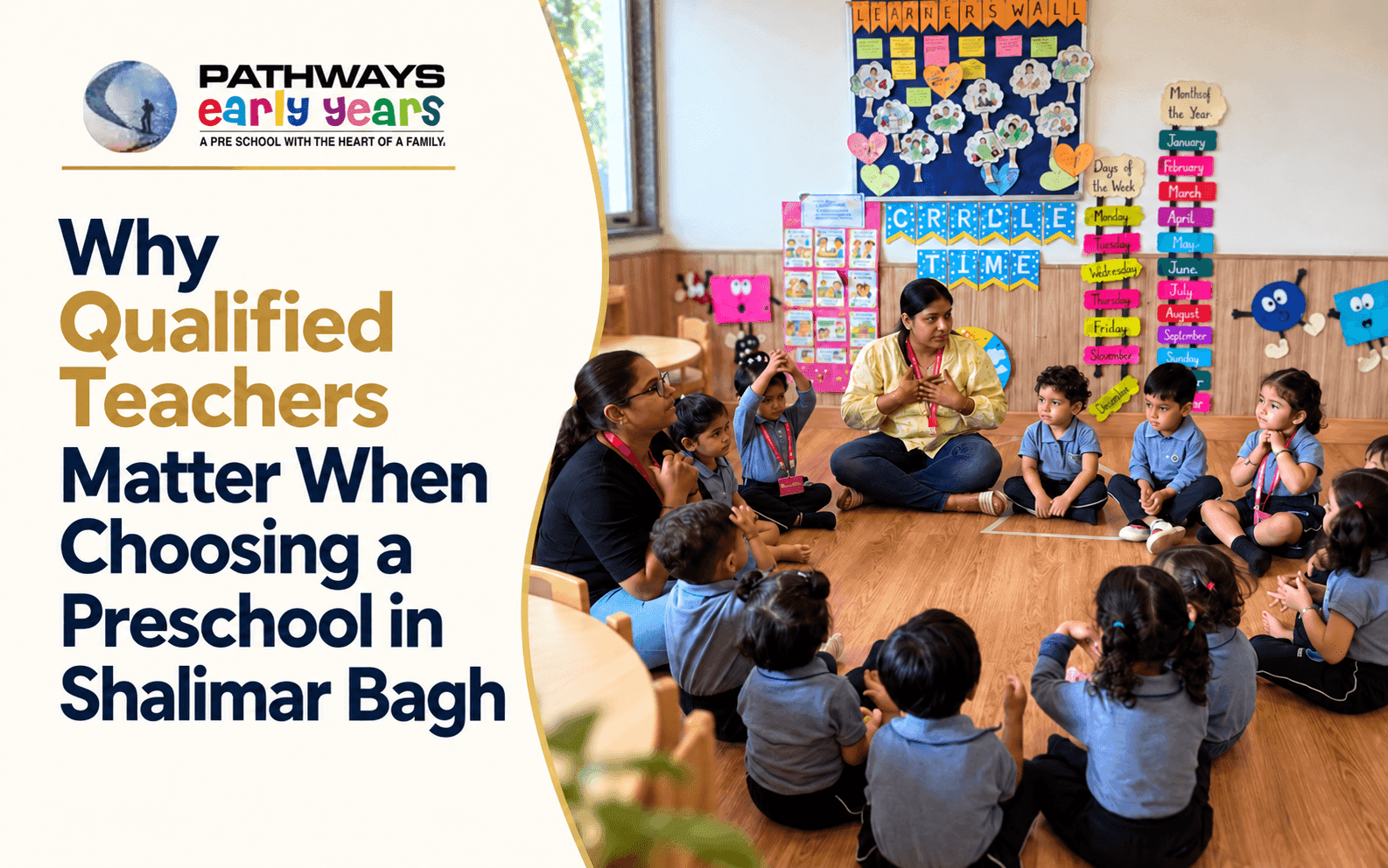
Discover why qualified preschool teachers matter and how their expertise supports your child’s learning, confidence, safety, and holistic development.
Walk into any preschool today and you'll see bright walls, colourful play corners and the latest learning apps. It's easy for these visuals to shape a parent's first impression. But ask any early-childhood expert, and they'll say the same thing: the person who matters most in that classroom is the teacher.
If you're evaluating a preschool with qualified teachers in Shalimar Bagh, you're already asking the right question. A child's early years are shaped less by furniture and gadgets, and more by daily conversations and the quality of attention they receive. A well-trained teacher notices when a child is hesitant to share, ready for a new challenge, or simply needs reassurance. This article looks at what "qualified" really means, why it matters in the early years, and how parents in Shalimar Bagh can evaluate it for themselves.
What Does a Qualified Preschool Teacher Mean?
A qualified preschool teacher is someone whose formal training and daily practice reflect a genuine understanding of how young children learn, feel and grow. Qualification isn't a single certificate — it's a combination of education, hands-on skill and temperament.
Parents evaluating preschool teacher qualifications should look beyond a framed degree. Meaningful qualifications typically include:
Formal education in early childhood development or a related field
Preschool or Montessori-style training, where relevant to the school's approach
A working understanding of age-appropriate learning methods
Awareness of child psychology and developmental milestones
Practical classroom management skills for short attention spans and big emotions
Basic safeguarding knowledge and first-aid awareness
Access to ongoing professional development, not just a one-time course
Equally important are qualities no certificate fully captures: patience, empathy, observation and clear communication. Trained early childhood educators combine both — knowledge and the temperament to apply it consistently, day after day.
Why Qualified Teachers Are Essential in Early Childhood Education
The preschool years, roughly between two and six, are widely recognised as a foundational period for brain development, language acquisition and social learning. What happens in the classroom during these years shapes how a child approaches learning for years to come.
Qualified early-years teachers play a direct role in:
Building a child's confidence to try new things without fear of failure
Establishing a positive, curious attitude towards learning
Supporting independence in small, age-appropriate ways
Creating emotional security through predictable routines
Recognising that children learn differently — through movement, stories or hands-on tasks
Identifying developmental strengths or concerns and flagging them sensitively
Easing the transition from home to school, especially with separation anxiety
None of this happens by accident. It requires a teacher who understands child development well enough to read small cues and respond appropriately.
How Qualified Teachers Support Holistic Child Development
Holistic child development means growth across several interconnected areas — language, social-emotional skills, thinking, physical coordination and creativity. A qualified teacher weaves all of these into everyday classroom activities.
Language and Communication Development
Trained teachers build vocabulary and listening skills through storytelling and simple word games, asking genuine questions that encourage children to form their own sentences and build phonological awareness naturally.
Social and Emotional Development
Sharing a toy or resolving a small disagreement are big milestones for a young child. Qualified teachers guide these moments calmly, helping children name their feelings and build early friendships.
Cognitive Development and Problem-Solving
Simple puzzles, sorting games and "what happens if" questions encourage children to observe, predict and reason, building early problem-solving confidence.
Physical and Motor Development
Outdoor play, drawing and climbing build fine and gross motor skills. Qualified teachers plan these activities purposefully, ensuring a healthy mix of movement and hands-on tasks.
Creativity and Imagination
Music, role-play, open-ended art and storytelling give children room to imagine without a "right" answer. Trained early-years teachers protect this space, encouraging expression over perfection.
Qualified Teachers Make Play-Based Learning Meaningful
Play-based learning in preschool is often misunderstood as simply "free time." In reality, purposeful play requires as much planning as any formal lesson — and this is where teacher expertise becomes visible.
A trained teacher approaches play-based preschool activities by:
Planning play experiences with specific learning goals in mind
Observing children closely to understand their interests and needs
Asking open-ended questions that extend thinking
Introducing new vocabulary naturally as children play
Encouraging collaboration between children
Adapting the difficulty of a task to each child's ability
Connecting the play activity back to a learning outcome
Allowing genuine exploration without rushing towards a "correct" result
A practical example: children building a tower with wooden blocks looks like simple play. A qualified teacher uses it to support counting, language ("taller," "wobbly"), coordination, problem-solving and turn-taking — one activity, several developmental gains.
The Importance of Personalised Attention in Preschool
Young children don't develop on a fixed schedule. Two children of the same age may differ significantly in language, confidence or motor skills, and this is entirely normal. Personalised learning in preschool depends on teachers who notice and respond to these differences.
Qualified teachers typically:
Observe each child's interests, pace and comfort level over time
Adjust their teaching approach for different learning styles
Give shy or hesitant children gentle encouragement rather than pressure
Offer suitably challenging tasks to children who are ready for more
Avoid comparing children against each other
Keep simple records of each child's progress
Share specific, useful observations with parents rather than generic updates
The preschool teacher-child ratio is a genuinely useful factor to ask about, but a low ratio alone doesn't guarantee quality. A well-trained teacher with good classroom systems can provide meaningful individual attention; ratio and teacher quality need to be considered together.
How Experienced Teachers Create a Safe and Nurturing Classroom
Safety in a preschool covers both physical and emotional aspects. Experienced preschool teachers in Shalimar Bagh — and elsewhere — build this sense of safety through consistent, everyday practice.
This includes:
Predictable classroom routines that help children feel secure
Positive behaviour guidance instead of harsh correction
Respectful, age-appropriate communication at all times
Basic child safeguarding awareness built into daily supervision
Consistent hygiene and supervision during play and meals
Sensitive handling of separation anxiety, especially early on
Calm, reassuring responses to emotional outbursts
Encouraging children to express themselves, not suppress emotions
Building an inclusive classroom where every child feels they belong
A safe preschool in Shalimar Bagh isn't defined by locked gates alone — it's equally defined by whether a child feels comfortable enough to ask for help or be themselves. Parents who need extended support can also explore the school's day care programme and assess its routines, supervision and care practices.
The Role of Teachers in Parent-School Partnership
Consistent communication between teachers and parents helps a child experience continuity between home and school. This partnership works best when it goes beyond routine updates.
Meaningful parent-teacher communication in preschool typically involves:
Sharing specific progress updates rather than generic remarks
Discussing emerging strengths and areas needing gentle support
Understanding the child's routines and habits at home
Working towards consistency between home and classroom expectations
Offering practical, age-appropriate suggestions parents can use
Respecting family privacy and individual circumstances
Conducting constructive, two-way conversations rather than one-sided reporting
A daily photo has its place, but it doesn't replace an actual conversation about how a child is settling in.
Questions Parents Should Ask About Preschool Teachers
Use this checklist during preschool visits:
What early-childhood qualifications do the teachers hold? Shows whether staff have formal training, not just general teaching experience.
How much experience do they have with this age group? Handling a two-year-old differs greatly from a five-year-old.
Does the preschool provide ongoing teacher training? Keeps staff updated as practices evolve.
How do teachers manage separation anxiety? Reveals how patient and structured settling-in is.
How is each child's progress observed and documented? Look for specific methods, not vague reassurances.
What is the teacher-child ratio? Ask alongside how much individual attention children actually receive.
How do teachers respond to behavioural or emotional challenges? Shows their approach to discipline and support.
How does the school communicate with parents? Frequency and depth both matter.
How are safety and safeguarding practices maintained? Should cover premises and staff conduct.
Can parents observe how teachers interact with children? A confident school will usually welcome this.
What Parents Should Observe During a Preschool Visit
During a visit, look for these positive signs:
Teachers speaking to children at their eye level
Warm, respectful interactions rather than purely instructional ones
Children encouraged to ask questions freely
Calm, unhurried classroom management
Teachers actively participating in activities, not just supervising
Simple, age-appropriate language used consistently
Every child included in group activities, regardless of ability
A healthy balance of guided tasks and independent exploration
Children who appear relaxed and comfortable
Teachers listening to children as much as they instruct them
Be equally attentive to less reassuring signs — a rushed tour, disengaged staff, or an unwillingness to answer questions about training and ratios.
Choosing a Preschool with Qualified Teachers in Shalimar Bagh
For families comparing options locally, choosing a preschool with qualified teachers in Shalimar Bagh comes down to evaluating several factors together rather than any single feature:
The formal qualifications and relevant experience of the teaching staff
Their comfort and skill with the specific 2–6 age group
The teaching approach — structured, play-based or a blend of both
How teachers handle emotional care and individual differences
Everyday safety and safeguarding practices
The genuine level of personalised attention children receive
The depth and regularity of parent communication
Practical factors like accessibility and location within Shalimar Bagh
Whether the school's stated philosophy matches what you observe in the classroom
Schools such as Pathways School in Shalimar Bagh are among the options families consider, and it's worth evaluating any shortlisted school against the same criteria above rather than marketing claims alone. The "best preschool" isn't defined by its building or technology — it's the place where qualified teachers help a child feel secure, heard and excited to learn.
Conclusion
Choosing where your child spends their first years of structured learning is rarely a small decision. While infrastructure is easy to notice, it's the quality of everyday teacher-child interaction that shapes how a child feels about learning and themselves. A preschool with qualified teachers in Shalimar Bagh gives your child a foundation built on genuine understanding, patience and consistent care, not just appearances.
As you shortlist schools, take time to observe real classroom interactions, ask the questions outlined above, and trust what you see during a visit. If you'd like to understand a school's early-years approach more closely, contact Pathways Early Years to arrange a conversation or visit and speak directly with its teachers — one of the most reliable ways to judge whether a preschool is truly the right fit for your child.
About the Author
Pathways Early Years Team
Frequently Asked Questions
Qualified teachers understand how young children think, feel and learn, allowing them to respond appropriately to each child's needs. This shapes a child's confidence, emotional security and early attitude towards learning. Without this understanding, even well-designed activities may not achieve their intended developmental benefit.
Ideally, a preschool teacher should have formal training in early childhood education or Montessori methodology, along with an understanding of child psychology, safeguarding and age-appropriate teaching methods. Ongoing professional development is equally important, as is demonstrated patience and communication skill in daily practice.
Parents can ask about formal qualifications, relevant age-group experience and training practices, then observe an actual class or visit. Watching how teachers speak to children, manage routines and respond to emotions gives a clearer picture than qualifications alone.
There's no single universal number, as suitable ratios vary by age group and classroom support. Rather than focusing on ratio alone, parents should also assess how much genuine individual attention children receive during a typical day, since teacher quality and classroom support matter alongside numbers.
Yes. Purposeful play-based learning requires careful planning, observation and guidance, all of which depend on a teacher's training. A qualified teacher uses play to build language, social, cognitive and physical skills simultaneously, rather than leaving children unsupervised during "free time."
Start by checking teacher qualifications, experience and training practices, then visit in person to observe real classroom interactions. Ask about safety practices, communication with parents and teacher-child ratios, and trust your own observations of how comfortable and engaged children appear.
Get in Touch
Still have questions? Fill out the form below and our team will get back to you shortly.